
How Arshad Bahl Built AMRITA
When I interview a founder, I always start with their childhood.
I do that partly because of my own story. My maternal grandfather was an immigrant and a commercial photographer, and when people ask me how my career began, I take them back to the day he put a camera in my hand. And he told me to notice what’s right in front of me.
The seeds of who we become are usually planted early. You have to know where to look.
When I sat down with Arshad Bahl, the founder of AMRITA Health Foods, I asked him to take me back to the beginning. What I heard was one of the most heartfelt immigrant founder stories I’ve heard in a long time.
It is also a story with a lesson that every food and beverage entrepreneur should hear.
A Childhood Across India
Arshad was born in Calcutta, in eastern India. But he didn’t stay there long. His father worked in sales for a British company and opened its offices across India. Every two years, the family packed up and moved to a new city.
For a young boy, that meant constant change: new schools, new friends, new languages. But Arshad sees it as a gift. India is incredibly diverse, and he got to see it up close. Different cultures. Different customs.
And above all, different food.
Food was at the center of everything. He told me how a tiny pinch of saffron transforms the rice served at weddings and special occasions. He learned early that some foods are everyday, like rice and beans, while others are the accents that make a meal unforgettable.
That understanding of delicate, intentional flavor still guides how he thinks about every product he makes.
India also taught him resilience.
“It’s a country of millions and millions of people,” he said. “You’re always going to have setbacks. You’re always going to have competition. You have to figure out a way to be unique.”
The irony is that he wasn’t encouraged to be unique growing up.
Smart kids were expected to become doctors or engineers, not artists or entrepreneurs. Still, the lesson stuck with him. To survive intense competition, you need a story and something that sets you apart.
His parents taught him the deepest lessons. Whenever Arshad came home with good news, his father never said, “Great job” or “Take a break.” His first response was always the same.
Donate 5% to those less fortunate. His mother said something similar, in her own way. You’ve been given something good. Life always involves luck. Give back.
Both of his parents have passed away in the last two years, his mother very recently. He told me he thinks constantly about what they gave him growing up. You can hear it in his voice.
And as you’ll see, you can see it in how he runs his business.
A $1,200 Check and a Suitcase
At 18, Arshad earned a scholarship to St. Lawrence University in upstate New York. He arrived with a $1,200 check and a suitcase of clothes. “That was all the money I ever got from India,” he said.
He couldn’t afford to go home. So during the summers he took the jobs other students didn’t want. He painted fences. He washed dishes. He did manual labor for four straight years to stay in school. A year after he left, his parents and younger sister immigrated to Toronto, which is why he holds both American and Canadian citizenship today.
What moved me most is that he never let go of where he came from. He was fortunate to live in multicultural places where he could get a Western education and learn a Western way of doing business without giving up his roots.
AMRITA is a Sanskrit word meaning the nectar of immortality. The package colors are deeply Indian. His heritage isn’t a marketing angle. It’s who he is.

Checking Every Box
Arshad studied math and physics as an undergraduate, partly because of that early push toward technical fields. He went on to graduate school in applied math and then spent about six years at the EPA building public health policy, work like setting safe mercury limits for people who eat shellfish.
A consulting job introduced him to business, and he became fascinated with a question that still drives him. How do profit and doing good fit together? That curiosity took him to business school at UNC Kenan-Flagler, close to where I’ve lived for most of my life and where I’ve spoken many times. From there he worked at Nortel and then spent nearly 13 years at IBM, evaluating startups and rotating through operations, finance, and marketing.
By every measure his parents would have recognized, he was succeeding.
Scholarships, graduate school, business school, a steady climb at a respected company. Check, check, check. But he wasn’t happy. He loved the work and hated the politics. So around the age of 40, while still at IBM, he started building AMRITA on the side.
A Farmers Market and a Father’s Love
Here is the part of the story I keep coming back to.
Arshad’s son, Ayaan, was diagnosed at 2 years old on the autism spectrum.
Like many kids on the spectrum, he struggled with eye contact. Arshad came up with an idea. They would go to the local farmers market together and hand out bars to strangers. His son would practice looking people in the eye and asking, “Would you like to try one?”
He wasn’t there to sell anything. He was there to help his son.
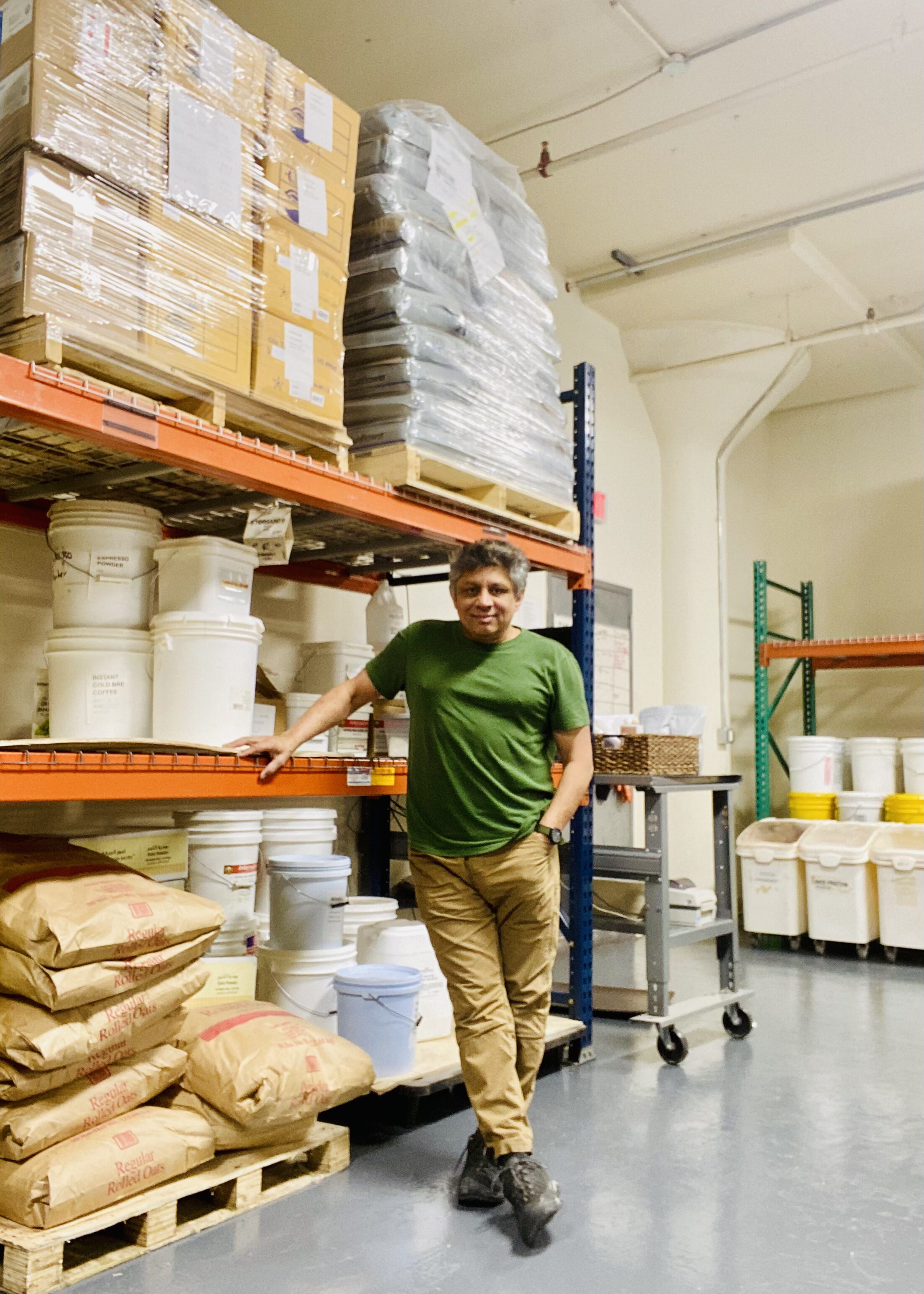
One day a woman stepped off the train, tasted a bar, and loved it. She turned out to be Whole Foods’ regional forager. She invited him to come in. Soon AMRITA was in two Whole Foods regions. For the first few months, Arshad and his family made the bars in their home kitchen, “praying nothing would go wrong.” Eventually they moved to a co-packer, and six years ago he opened his own production facility.
He still loves getting his hands dirty there. The day we spoke, his team had packed 17 pallets bound for Amazon. He could have delegated it all. Instead, he worked alongside his team and met each delivery truck himself. He spent ten minutes chatting with the Estes driver and sent him off with a box of bars. “In this digital world, we’ve lost touch with human interaction,” he told me.
I understood that completely. When I ran our brownie bakery with my wife, I’d tell our bakery manager, Lois, I just needed to make brownies that day.
I needed to get out of my head and back to the people and the product.
The Reluctant Businessman
Arshad calls himself a reluctant businessman. He borrowed the idea from Yvon Chouinard, Patagonia’s founder, who never wanted to be a businessman and grew uncomfortable when his fleece vests became a Wall Street uniform. “That’s exactly the person I aspire to be,” Arshad said.
For him, money is a tool to do good. He isn’t shy about charging a fair price for an excellent product, but what matters most is what happens with the profit. AMRITA runs at a net profit of 8% to 9% today, and he aims for 15% to 20%.
For context, he pointed out that many big grocers and distributors run on 2% to 3%. He lives modestly and donates the rest. His father’s 5% rule echoes in his head and heart.
It hasn’t been easy.
About a year ago, he was feeling a bit burnt out and ready to hang it up. Instead of quitting, he dialed things back. He’s working to hand off the parts of the business he doesn’t enjoy, like HR, so he can focus on what he loves: ingredients, new recipes, and talking with customers.
Be Small, Be Profitable
Arshad talks with three or four founders a week. Almost all of them are burnt out. The reasons are usually the same. They took on too much money and feel pressure to pay it back. Or they feel they have to be in more channels and more stores because it looks better.
His advice is the opposite.
Do less.
Pick fewer channels and be the best at them.
If you’re in retail, focus on four or five chains and drive velocity instead of chasing more doors.
He has set his own ceiling at ~ $10 million.
Past that, he believes, a business becomes a target. Lawsuits pile up, pressure builds, and the founder stops enjoying the work. He also sees through the headlines. When a brand sells for $150 million, nobody mentions that it raised $60 million to get there, and that the founder may walk away with very little.
“If you got into this industry because you’re passionate about food, you want to be doing it on your agenda and your timeline, not somebody else’s,” he said. “If you want to take a year off and travel the world, your company shouldn’t go under because of that.”
As I listened, I realized this thread ran through his entire life. In India and even at IBM in the Research Triangle, he kept coming back to the same place in every chapter.
This is too big. I want it to be smaller. And simpler. “Simplicity equals excellence,” he told me.
I know that feeling. Thirty years after we sold our brownie business, I still get emails from people who remember buying our brownies at Wawa in Pennsylvania.
That kind of connection doesn’t come from size. It comes from doing one thing with heart.
Three Key Takeaways
1. Decide how big you want to be before someone else decides for you. Every dollar of outside capital comes with an agenda. Know your own number, and know why, before you take money that pushes you past it.
2. Small and profitable beats big and burnt out. Focus on fewer channels and win there. Velocity in the right stores matters more than more doors.
3. Your story is your difference. Arshad’s roots, his parents’ lessons, and his son’s farmers market days aren’t side notes. They are the brand. Founders who know where they come from build businesses that people remember.
Arshad Bahl came to America with a $1,200 check and a suitcase, and he still measures success by what he gives away.
Connect with Jeff at The Marketing Sage Consultancy. Interested in setting up a call? Use my calendly to schedule a time to talk. The call is free, and we can discuss your brand, marketing needs, and challenges.
Feel free to email me at jeffslater@themarketingsage.com or text 919 720 0995. Thanks for your interest in working with The Marketing Sage Consultancy.