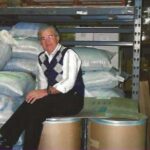
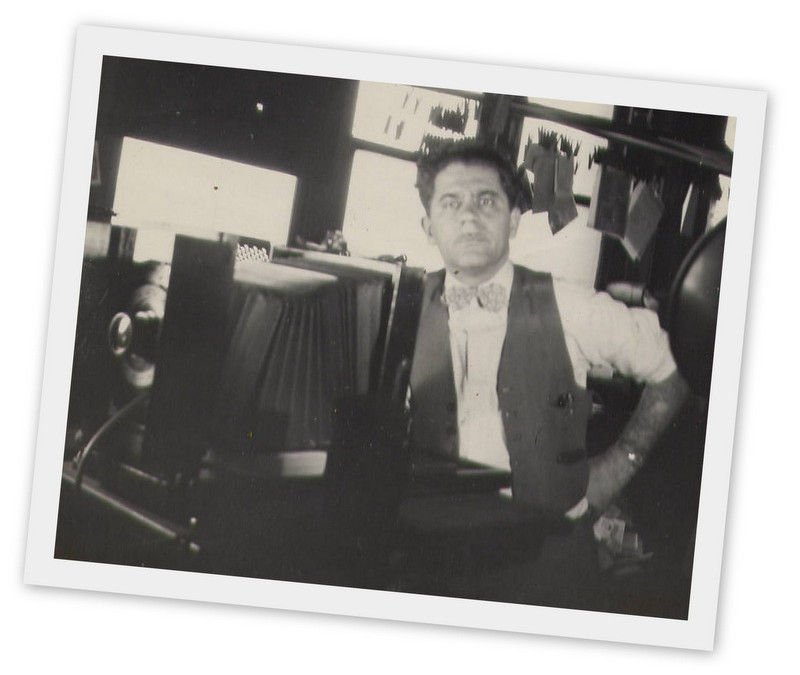
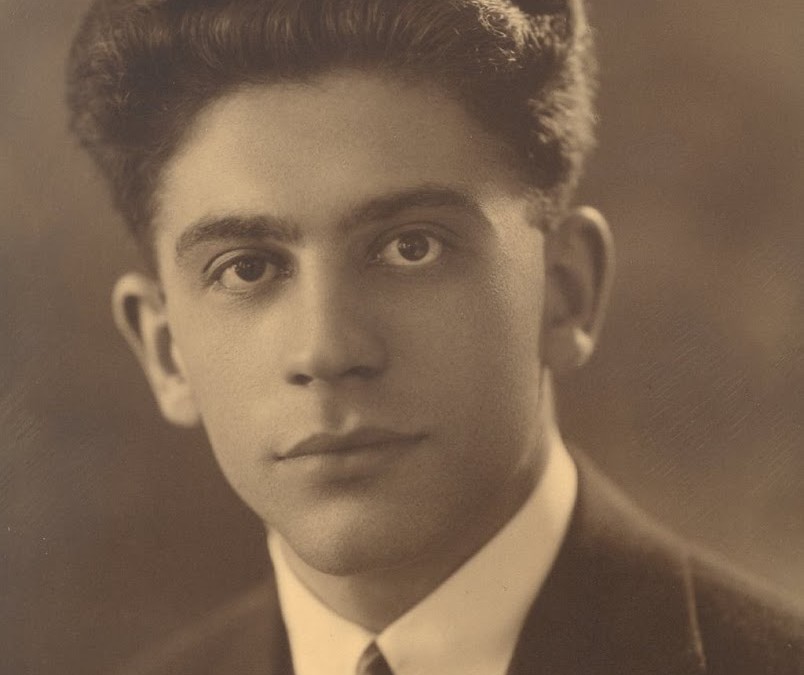
It has been 30 years since my maternal grandfather, Poppa George, passed away. But there isn’t a day that I don’t think about him and his journey as an immigrant to the United States. As the country turns 250, I want to honor and memorialize Poppa George.
He came to America on a boat from St. Petersburg in 1910. He was ten years old. He was alone. His mother died when he was 5. His father remarried, and, according to Pop, his stepmother was unkind.
Pops’ father thought he should go to America.
Then, his father died a few years later.
His two sisters stayed behind in Russia.
Whatever pocket change he carried was stolen from him by some thugs on the ship.
Pop would say that, for all 96 years of his life, he came to America without two nickels to rub together. And everything he had when he eventually leaves this world was all profit.
That nickeless boy was my grandfather.
His name was Gricha back in Russia. In America, in the care of his Uncle Henry and Aunt Pauline in Newark, New Jersey, he became George.
George Ginsberg.
And if you ever had the pleasure of meeting him, you never forgot him.
Pop died in 1996 at the age of 96, just shy of his 97th birthday. The New York Times ran his obituary. They called him the Penny Philanthropist. That title tells you almost everything you need to know about who he was. But the whole story is richer, stranger, and more remarkable than any headline can hold.
The Boy Who Came Over Alone
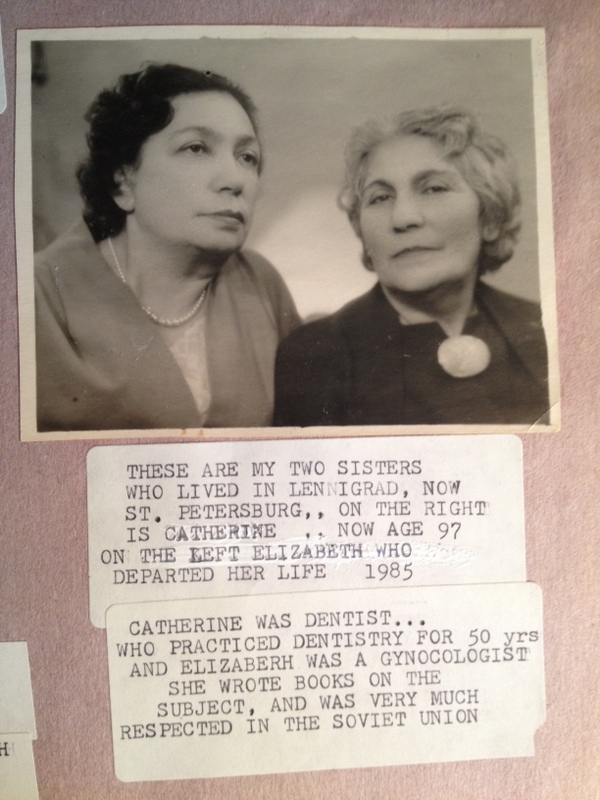
George’s parents died when he was young, leaving him an orphan in Russia alongside his two older sisters, Kate and Elizabeth. The family decided. George would go to America. Uncle Henry, who had already made the crossing, would take him in and give him a start.
My older sister Diane remembers hearing the details differently.
She reminded me that when Pop was 10, he was sent to the United States to get away from the war and the White Russians. She recalled hearing that Russians were kidnapping nine and 10-year-old boys and sending them out on the front to check and see if the soldiers were getting closer. Pop’s father, who was alive when Pop came to America, arranged for him to live with Uncle Henry in Newark.
In our family, we used to say, “ask Annette”. Our mother’s sister would always know the facts. I used to say, who needs the Internet when you have our Aunt Annette.
But our beloved Aunt is no longer with us. So the facts evade us.
In any event, Pop’s sisters stayed, and at age 10, Pop came to America.
The sisters were remarkable women by any measure. Both became doctors. Kate (Catherine), who was a dentist. Elizabeth was a practicing gynecologist who later wrote books in her field.
For Jewish women in early-20th-century Russia to achieve that level of professional standing, they had to be exceptional. Both lived long lives and built successful careers. George honored them throughout his own life by keeping their stories alive for his family.
There is one more thread worth pulling here.
George’s first cousin was Irène Némirovsky, the award-winning author of Suite Française, the stunning unfinished novel she wrote just before the Nazis arrested her at her home in France in 1942. The book was published by her daughter, Denise, in 2004.
Irene died in Auschwitz in 1942. George carried that grief as part of his story, too. When you understand what was left behind in Russia and Europe, you understand why he spent his entire American life in a state of profound and active gratitude.
The ten-year-old who boarded that boat had no way of knowing what was ahead. He just knew he was going on a long journey.
Uncle Henry’s Apprentice
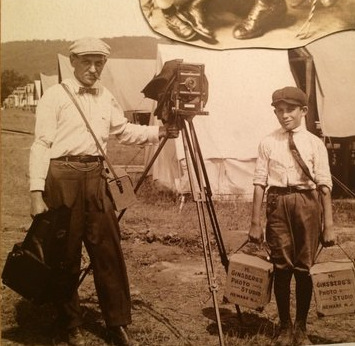
Uncle Henry was a funny man with a sly sense of humor and was a working commercial photographer. George landed in Newark with nothing but his willingness to pick up a camera and soak up his uncle’s joyful disposition.
For his entire life, he always had his camera and an irrepressible sense of humor.
Photography became his trade, his art, his livelihood, and eventually his obsession. He learned to see the world through a lens and understood that a photograph is a promise. A moment happened, and a photograph makes sure it lasts.
That instinct shaped everything that came after.
Quaker Photo and the Camera Truck
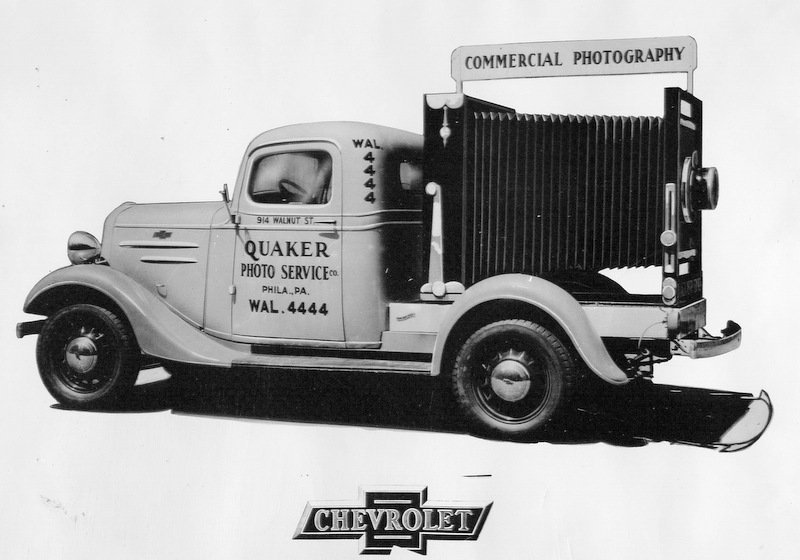
By 1920, George had a small commercial photography studio in Philadelphia called Quaker Photo. He had a wife, my Grandma Fannie, and eventually two daughters, Annette and Beatrice. Bea, born May 22, 1927, is my mother.
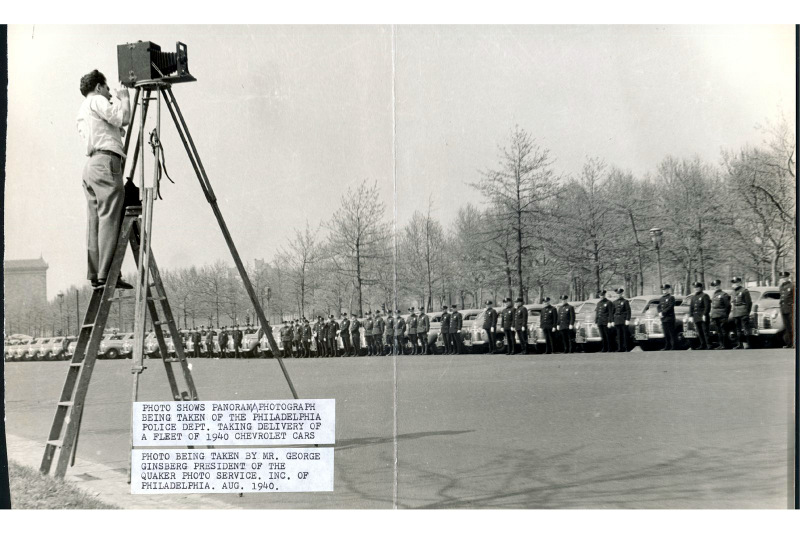
Work meant commercial photography. Covering the sesquicentennial in 1926, celebrating 150 years of American independence, and capturing the city at work and at play. Photographing the Philadelphia Police Department when their new Chevrolet patrol cars arrived in 1940
But the idea that still makes me shake my head was the camera truck.
George built it himself with some wood, paint, and help from friends at Chevrolet. He shaped the truck to look like his large-format camera and bellows. He painted his phone number on the side: Walnut 4444. Then he drove it through the streets of Philadelphia.
This was the 1920s. The food truck concept, the branded vehicle, the rolling advertisement. All of it. Pop did it decades before the Oscar Mayer Wienermobile, decades before anyone had a name for it.
It worked exactly the way you’d expect. He’d pull up to a job in a new neighborhood, and people would come outside to look. The camera truck pulled strangers close and turned them into customers. George Ginsberg had a magnetic personality and everything he did drew people closer to him – and his camera truck.
You got near him, and you were drawn in. The truck just extended its radius.
He was a marketing genius before anyone even knew what marketing or branding was about. I know I got a few of his genes, but he was the original sage.
The Book – Documenting Our Family
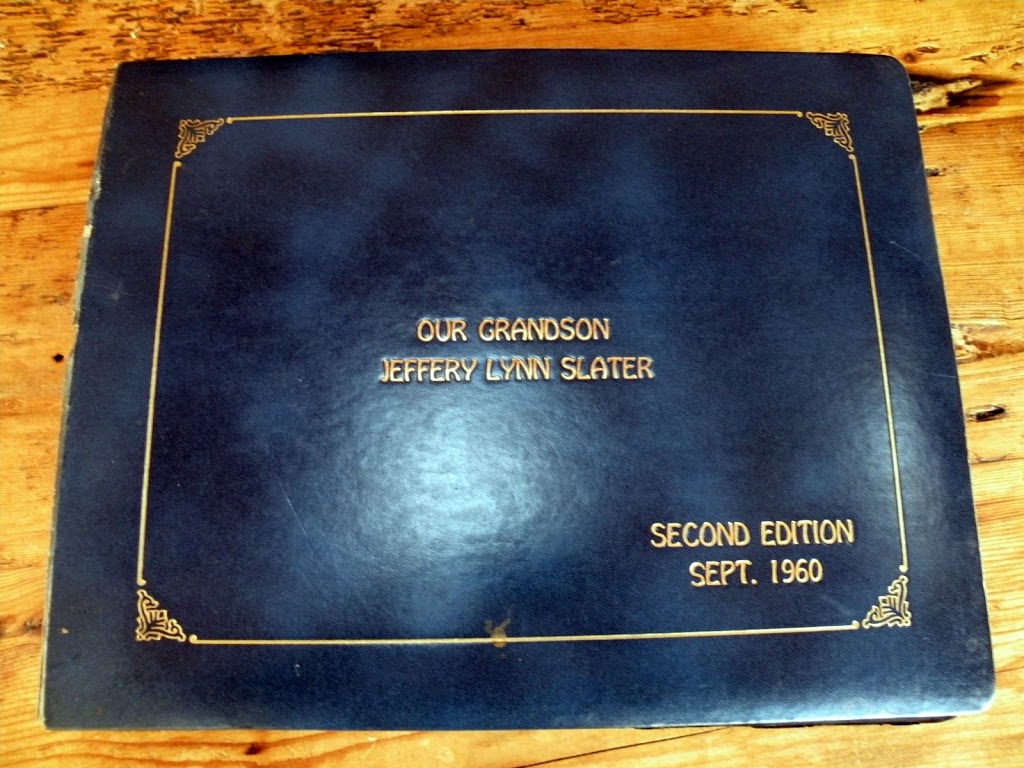
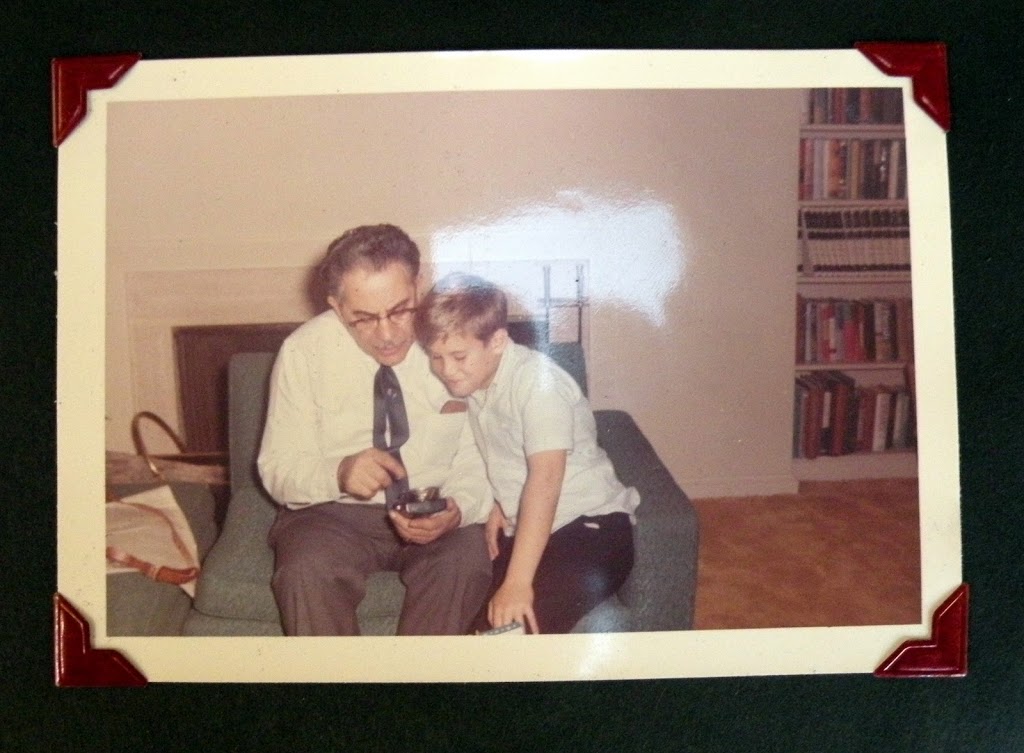
Pop’s most important photographic work was lovingly known by our family as The Book.
Every year of my childhood, he made a photo album for each of his three grandchildren, starting in 1950 when my sister Diane was born, then me in 1954, and Mitch in 1960.
Not a simple album. A handcrafted scrapbook, assembled with corner holders and Elmer’s glue, packed with photographs, newspaper clippings, ticket stubs, and any small piece of paper that documented your life. When each one was complete, he had the cover stamped in gold leaf with your name, the edition, and the year.
Our Grandson Jeffrey Lynn Slater. Second Edition. September 1960.
I have over 21 of them. My sister and brother have at least as many. When his great-grandchildren started arriving in 1976, he made the books for them too, for Jaime, Garrett, Sarah, Fanny, and Harrison.
Sadly, his last great-grandchild, Georgia, never got any of his books – but has the blessing and honor of carrying his name.
When I take one of those albums off the shelf now, I am instantly transported in my own time machine.
My seventh birthday party with my neighborhood buddy, Philip Norulak, both of us wearing paper crowns.My ninth birthday bowling party at Echo Lanes.
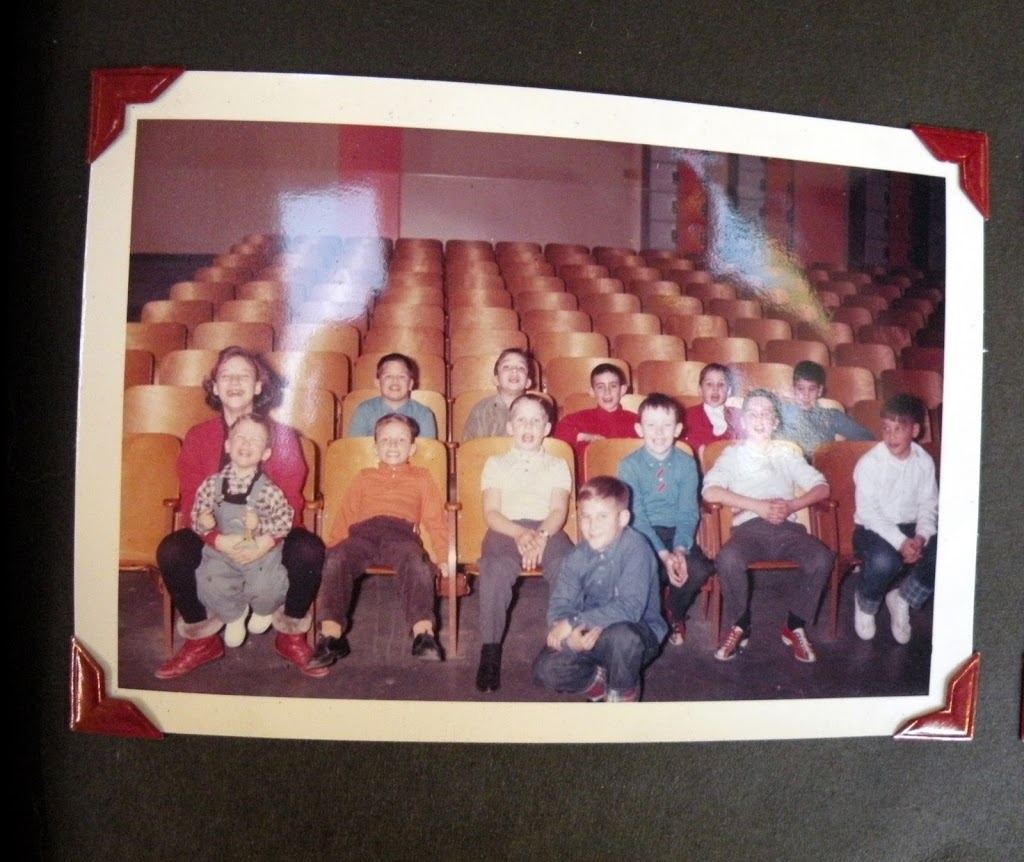
The trip to Washington, D.C., to see the cherry blossoms bloom with my sister Diane and cousin Janie. A photograph of the television screen showing Jim Bunning’s perfect game, June 21, 1964. Summers at Camp Winadu with my childhood best friend, James Farber. Travels to Israel, Mexico, and eventually the University of Pennsylvania.
Pop saved a two-inch clipping from the Springfield Sun reporting that my basketball team, the Lakers, had won a game in the small-fry league. They spelled my last name wrong. Two t’s instead of one. Pop saved it anyway. Because it happened, and it needed to go in The Book.
I think about why he did this. He grew up without parents. Without grandparents to pass things down. Without anyone to document who he was or where he came from. So, he made sure we would never feel that absence. He spent thousands of hours making sure that every one of us would always have evidence that we were seen, loved, and remembered.
Those albums are the most valuable possession my siblings and I own. And today, I honor my grandson Bodhi by making annual albums for him.
The Penny Philanthropist and The New York Times
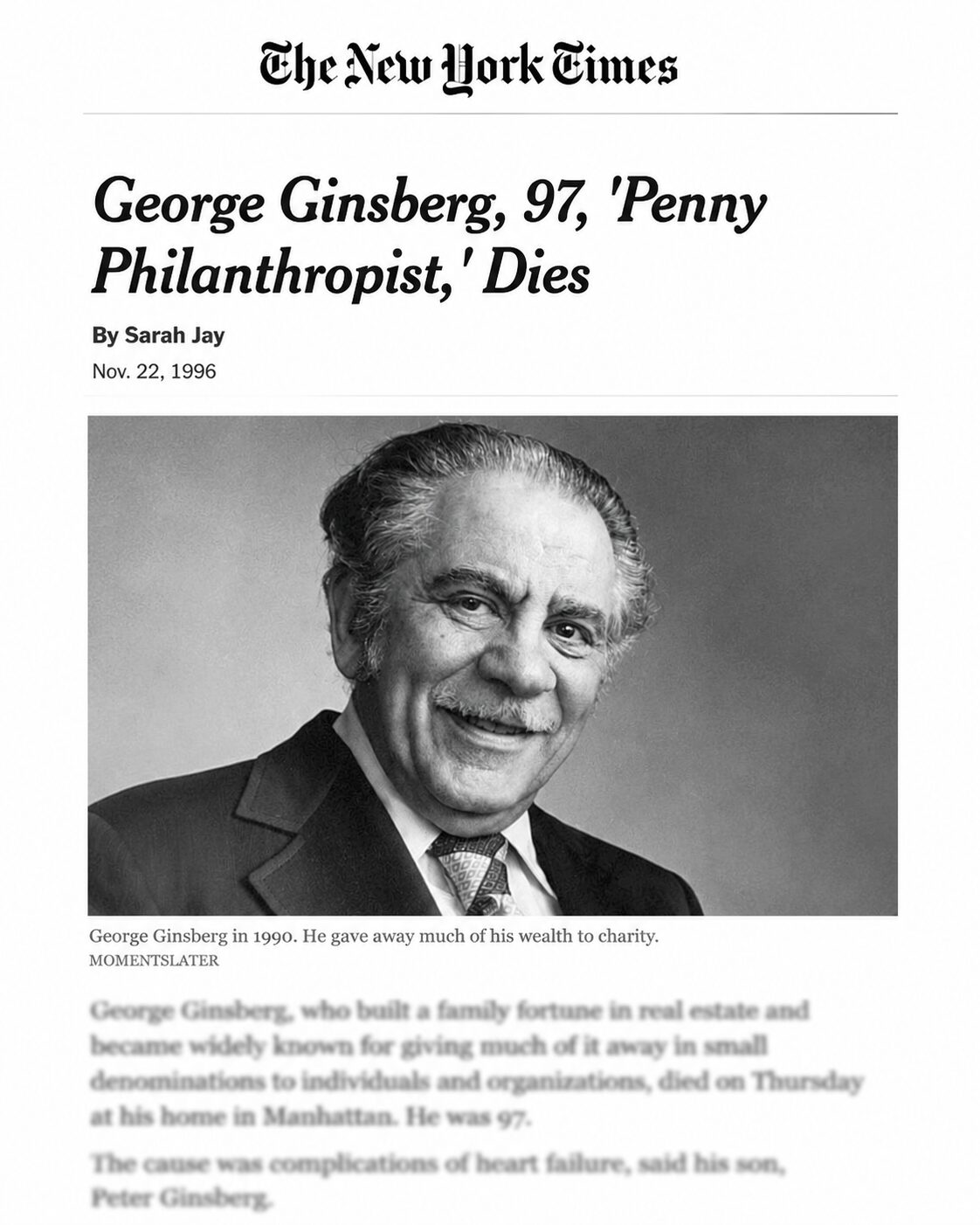
George Ginsberg was not a rich man. He and my Grandma Fannie lived modestly at 186 Tuxedo Parkway in Newark. Two bedrooms. Tight quarters.
I can smell the cinnamon on Grandma Fannie’s sour cream coffee cake baking in the oven. The sweet and sour fragrance of stuffed cabbage still fills my senses and memories when I see her photograph.
In their cramped apartment, the Mets are losing on television. Family everywhere. As grandchildren, it was like Buckingham Palace – and each of us felt royal and the richness of their love.
My grandfather had this odd habit.
Pop picked up every penny he found on the street.
He saved them, and then he wrote checks. Two dollars to the American Red Cross. Two dollars to the Cancer Society. Two dollars to a local veteran’s group. Hundreds of charities, over decades, in small increments. Not because the amounts were significant. Because the act was.
He was always talking about how lucky he was. Lucky to be an immigrant who got to start over. Lucky to have found his trade. Blessed with a family that prospered and cared for each other. George knew he was lucky to have Fannie as his wife, partner, and sidekick.
Lucky to be alive in a country that lets a ten-year-old orphan with no money own several photography businesses and gets to see his family grow and prosper.
The Helping Question
Every time I saw Pop, he would ask me a question at the end of each visit.
Jeffrey, who did you help today?
It wasn’t rhetorical. He wanted to know.
And I knew that he had his own answer ready, whatever form it took that day—a penny saved. A check was written. A story told to a grandchild so they wouldn’t forget where they came from.
George Ginsberg died in November 1996, eleven days before his 97th birthday.
The New York Times ran his obituary. Not because he was powerful or wealthy or famous in any conventional sense. Because of the pennies. Because of the two-dollar checks to hundreds of charities. Because someone at the paper understood that a man who spends his whole life finding small ways to help other people, who makes that his consistent and defining practice, is worth remembering and honoring.
The Times called him the Penny Philanthropist.
He would have loved that title.
He would have repeated it like one of his jokes, the same ones he’d been telling for twenty years, still getting his family to laugh every single time.
Did you know my grandparents are in iron and steel? My grandmother irons, and my grandfather steals. It still makes me laugh today.
The boy who arrived from St. Petersburg without two nickels to rub together died, known to the readers of the most important newspaper in the country. Not for what he accumulated.
For what he gave away.
What He Left Behind
I think about Poppa George a lot—more as I’ve gotten older, not less.
He built a business from nothing.
He invented a marketing idea decades before it had a name.
He documented his family with a photographer’s love and a storyteller’s instinct.
He honored the women in his life by making sure his grandchildren knew their names and their stories.
He gave away what little he had, consistently, without fanfare, because he believed that was what you were supposed to do.
He came here as a ten-year-old orphan with no parents, no money, and no language. He left behind 21 volumes of love on my shelf, a question I ask myself every night, and an obit in the Times.
Not a bad return on a boat ticket from St. Petersburg.
Three Life Lessons I Learned from George
Gratitude is a strategy, not just a feeling. George Ginsberg arrived with nothing and spent the rest of his life acting like he had been given everything. That posture, of genuine and active gratitude, shaped how he ran his business, how he treated strangers, and how he raised a family. It’s the reason his grandchildren still hear his voice before they go to sleep or think of the life he led.
Document what matters before it disappears. Pop understood something most people don’t act on: the present becomes the past faster than you expect, and the only things that survive are the ones someone took the time to save. Twenty-one handcrafted albums are more durable than any digital backup. They carry his fingerprints.
Small acts, done consistently, become a legacy. No single two-dollar check made a difference. All of them together, over decades, made him the Penny Philanthropist of the New York Times. The same principle applies to a business, a family, and a career. What you do every day is who you are. George knew that before anyone gave it a name.
So let me ask you a question.
Who did you help today?
Connect with Jeff at The Marketing Sage Consultancy. Interested in setting up a call? Use my calendly to schedule a time to talk. The call is free, and we can discuss your brand, marketing needs, and challenges.
Feel free to email me at jeffslater@themarketing sage.com or text 919 720 0995. Thanks for your interest in working with The Marketing Sage Consultancy.