
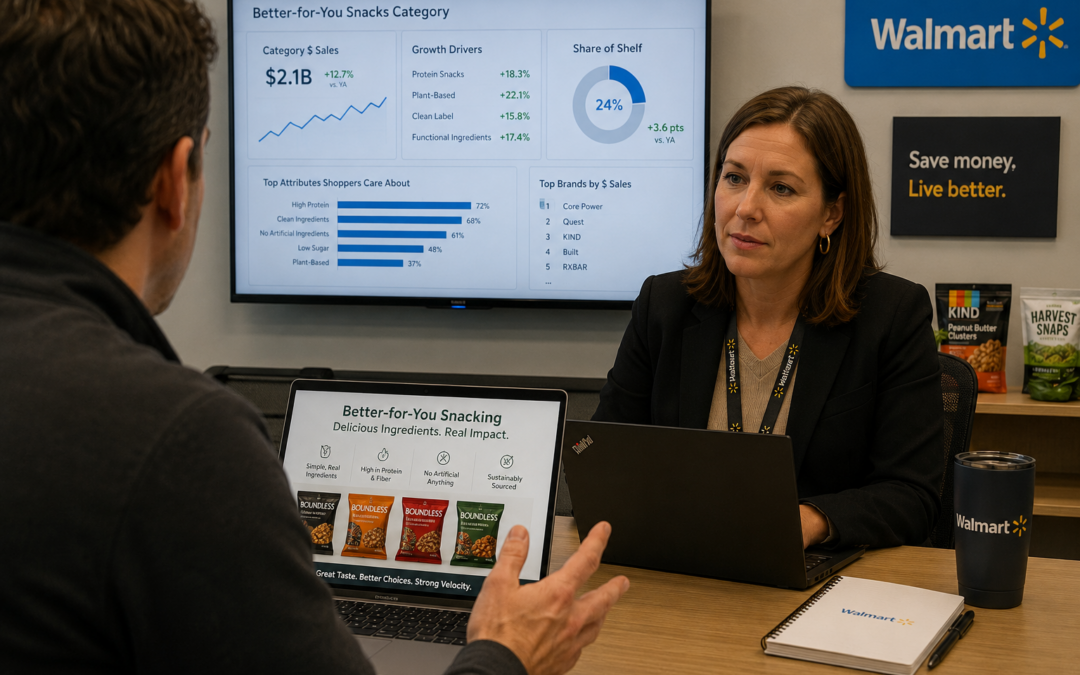
Early in my career, I was the one walking into a buyer’s office with samples in a cooler bag and a pitch deck I’d rewritten four times the night before.
Later, I spent years advising founders on how to survive that same meeting. I have talked with enough category managers and buyers over the years at Whole Foods, at regional grocery chains like Harris Teeter or HEB, and at mass and club retailers like BJ’s and Costco to know what they are actually thinking while they smile, nod, and taste your product.
They are not thinking about your product. Not really.
They are thinking about their category. Their shelf. Their P&L.
Your brownie, your bar, your sparkling whatever, is a line item in someone else’s spreadsheet before it is ever a treat in someone’s hand. Understanding that shift, from your story to their math, is the whole game.
So, I put myself back on the other side of the desk for this post.
I pulled together everything I have learned from those meetings, added in conversations with buyers and category veterans I trust. Many of these questions came from my friend Ron Mills, who is an outstanding national accounts sales consultant. Ron contributed to this article his deep experience selling more than one billion dollars of products to national accounts, traditional grocery, mass, c-stores and club outlets.
I built out the ten questions that come up again and again, whether you are sitting across from a seasoned buyer at a regional grocer or filling out a submission form on a retailer portal for the first time.
Some of these questions get asked out loud. Others sit quietly behind those who do. Either way, you need an answer.
Before you ever sit down with a buyer, walk their stores. Not just one. Visit locations in different neighborhoods and different income brackets and pay attention to what you see. How is the category merchandised? What sits next to what. What is priced where. How many people work the floor and how much do they seem to know about what they are selling?
Ron made a point I have seen prove true again and again. Retailers often run different strategies store by store depending on who lives nearby. Your product might be right for half their locations and wrong for the other half. Knowing that before you walk into the meeting does not weaken your pitch. It strengthens it, because it tells the buyer you understand their business well enough to know where you actually fit.
Timing matters as much as the pitch itself. Most retailers work on reset calendars, set windows during the year when they rework a category and decide what stays and what goes. Walk in after that window closes, and even a great pitch can sit on a shelf, so to speak, for months.
Know your retailer’s reset schedule and your own distribution path well enough to say with confidence that you can be on trucks and ready to ship the moment they say yes. A buyer who believes you are organized enough to hit their calendar is a buyer who takes you more seriously before you say another word.
Here is one nobody asks out loud, but every buyer is quietly grading you on. What do you actually add to their business beyond the product itself? Are you plugged into where the market is heading? Do you understand how their shopper behaves and what is shifting in that behavior?
Can you bring marketing muscle, a well-known name attached to the brand, real innovation, sharp data, or a clear read on the competitive set that they do not already have? Buyers are managing dozens of vendors, each of whom shows up with a product. The ones who stand out show up with insight, too.
The Money Questions
1. How does this grow my category, not just your brand?
This is the one every founder eventually hears, and it is the one most founders answer poorly. Buyers do not add SKUs because they like you. They add SKUs because a category needs to grow, and shelf space is a zero-sum game. If your item is going to cannibalize an existing item without bringing in a new occasion, a new shopper, or a new reason to buy, you have not made the case. Come with a clear point of view on what gap you fill and who you are pulling into the category who was not there before.
2. What proof and data do you have that this will sell and supports what you are saying?
Passion is not data. Buyers want velocity numbers from wherever you are already selling, whether that is a handful of independent stores, a regional chain, or a strong e-commerce channel. They want to see repeat purchase rates, not just trial. If you are pre-launch, they will settle for pre-orders, crowdfunding results, or a documented waitlist. What they will not settle for is a founder telling them the product is great because friends and family love it.
3. Do you have healthy margins, and can you support the cost of doing business with me?
Slotting fees, trade spend, promotional allowances, chargebacks for compliance misses. None of that is negotiable in the way founders hope it might be. A buyer needs to know, before they ever bring you to a category review, whether your cost structure can absorb the real cost of being on their shelf. If your margins are so thin that one failed promotion sinks you, that is a risk they see coming even if you do not.
Knowing your own margins is only half the job. You also need to know the buyer’s math and everything it takes to support them once you are on the shelf. That means pricing out every layer of the distribution path you plan to use, not just the distributor’s base upcharge. Many distributors run additional support programs on top of that upcharge, often another three to ten percent, and if you have not built that into your model, you will find out the hard way when your margin disappears somewhere between the warehouse and the shelf. Buyers respect a founder who has already done this math. It tells them you understand their business is not free to enter.
The Story Questions
4. Why you, and why now?
Buyers see hundreds of products a year that all claim to be cleaner, better, or more mission-driven than the ones that came before. What sticks is a founder who can explain, in one clear sentence, why they exist and why the timing is right. This is where your background matters. If you spent a decade in the category before starting your brand, say so. If you started this because you could not find the product you needed for your own family, say that too. The founder is part of the pitch, not a footnote to it.
There is a simple test hiding inside this question. Can you explain, in under a minute, the consumer problem you solve and exactly how you plan to reach that consumer and pull them into the buyer’s stores? Not your founding story in full. Not your whole product line. Just the problem, the solution, and the plan to get people buying. If you cannot say it in a minute, you have not finished the work yet. Buyers hear pitches all day. The founders who stick are the ones who can say the whole thing before the buyer’s attention drifts to the next meeting on their calendar.
5. What makes you different from what is already on my shelf?
Not different in a general sense. Different in a way that matters to their shopper. A buyer already has three or four brands doing roughly the same thing. If your answer to this question is a list of attributes- better ingredients, cleaner label, more protein- you are competing on ground that is easy to copy and hard to defend. The founders who win this question can point to a specific occasion, a specific flavor lane, or a specific shopper they own that nobody else in the set does.
6. Who is your target customer, and how do they find you in my store specifically?
A buyer is not just asking who buys your product. They are asking how you plan to pull that customer into your store, in front of your shelf, and have them reach for your item. If your answer stops at Instagram followers, you have not gone far enough. They want to know about in-store demos, retail media spend, influencer partnerships tied to specific markets, anything that moves a shopper from aware to buying, inside their four walls.
Can You Deliver Questions
7. Can your supply chain actually support this?
This is where many good products fall apart before they ever get the chance to fail on the shelf. Buyers have been burned by founders who said yes to volume they could not produce. They want honest answers about your co-packer relationship, your minimum order quantities, your lead times, and what happens if they ask you to scale from 50 doors to 500. Overpromising here does more damage to your reputation than admitting a limitation ever will.
8. Does your packaging work at three feet and at three inches?
A buyer is picturing your product on a real shelf, next to real competitors, seen by a real shopper who is moving fast and not reading closely. Can they identify what it is from three feet away? Can they understand the one thing that matters about it from three inches away, once they have picked it up? If your front panel is cluttered with certifications and claims competing for attention, it signals to the buyer that you have not yet made the hard choices.
9. Are you already selling somewhere else, and how is it actually performing?
This question is really about risk. A buyer would rather be the fifth retailer to carry you than the first. If you have real distribution elsewhere, even a small footprint, bring the numbers. Sell-through rate, reorder rate, any promotional lift you have captured. If you genuinely are pre-distribution, be ready to explain your plan to prove the model in a smaller setting before asking for a bigger commitment.
10. Are you built to be a long-term vendor, not just a good pitch?
This is the question that separates founders who get a purchase order from founders who get a real partnership. Can you handle EDI and the administrative side of being a vendor? Can you hit fill rates consistently? Will you show up to quarterly business reviews with data, not just enthusiasm? Buyers have long memories, and a rocky first six months with a brand follows that brand around internally for years.
Ron, who has spent his career on the national accounts side of these conversations, pointed out something worth admitting here. Questions seven and ten are really asking the same thing from two different angles.
Can you actually deliver, and will you keep delivering once the excitement of the launch wears off? I kept them separate because supply chain capacity and long-term vendor reliability tend to fail for different reasons; one is about production, and the other is about operations and follow-through, but Ron is right that they come from the same root concern. A buyer is not just asking if you can ship the first order. They are asking if they can count on you a year from now.
Why This Matters More Than the Taste Test
Founders spend enormous energy perfecting flavor, and they should. But the taste test is rarely what kills a deal. What kills a deal is a founder who cannot answer the questions above with confidence and specificity, because it signals to the buyer that the business behind the product is not ready for what shelf space actually demands.
The good news is that none of these questions are a mystery once you know they are coming. Walk in with real numbers, a clear story, and an honest read on your own operational readiness, and you will stand out simply by being one of the few founders in the room who came prepared for the meeting the buyer is actually having, not the one you assumed you would get.
Three Key Takeaways
1. Buyers are solving for their category, not your brand. Every question in this post traces back to the same root concern. Will this category grow, protect the margin, and reduce the buyer’s risk? Founders who reframe their pitch around the buyer’s math, rather than their own story, get further, faster.
2. Data beats passion every time. Velocity numbers, repeat purchase rates, and proof of demand from wherever you already sell will do more to earn a yes than any amount of founder enthusiasm. If you do not have that data yet, your job before the meeting is to get some, even at a small scale.
3. Operational readiness is part of the pitch. Supply chain reliability, packaging clarity, and the ability to function as a real vendor are not backstage details. They are exactly what experienced buyers are quietly evaluating while you talk about flavor and mission. Show up ready to answer for the business, not just the product, and you will be having a very different conversation than most of the founders who sit in that chair before you.
Can you answer all of these questions, or are you unprepared for that important sales call?
Special thanks to Ron for his contribution to this post. You can reach Ron at evolutionmills@gmail.com
Connect with Jeff at The Marketing Sage Consultancy. Interested in setting up a call? Use my calendly to schedule a time to talk. The call is free, and we can discuss your brand, marketing needs, and challenges.
Feel free to email me at jeffslater@themarketing sage.com or text 919 720 0995. Thanks for your interest in working with The Marketing Sage Consultancy.