A founder called me last month with a good problem.
Her spicy sriracha dipping sauces were selling out at every farmers’ market she showed up to.
Line out the tent. Repeat customers. The kind of validation that makes you feel like you’ve cracked it.
Her question was simple. “Should I go after Whole Foods next?”
My answer wasn’t simple, because that wasn’t the right question.
The real question isn’t which channel sounds like the next logical step up. It’s which channel she can afford to build, given the cash she has and the margin her product throws off. Get that wrong, and the farmers market win turns into a chain store disaster.
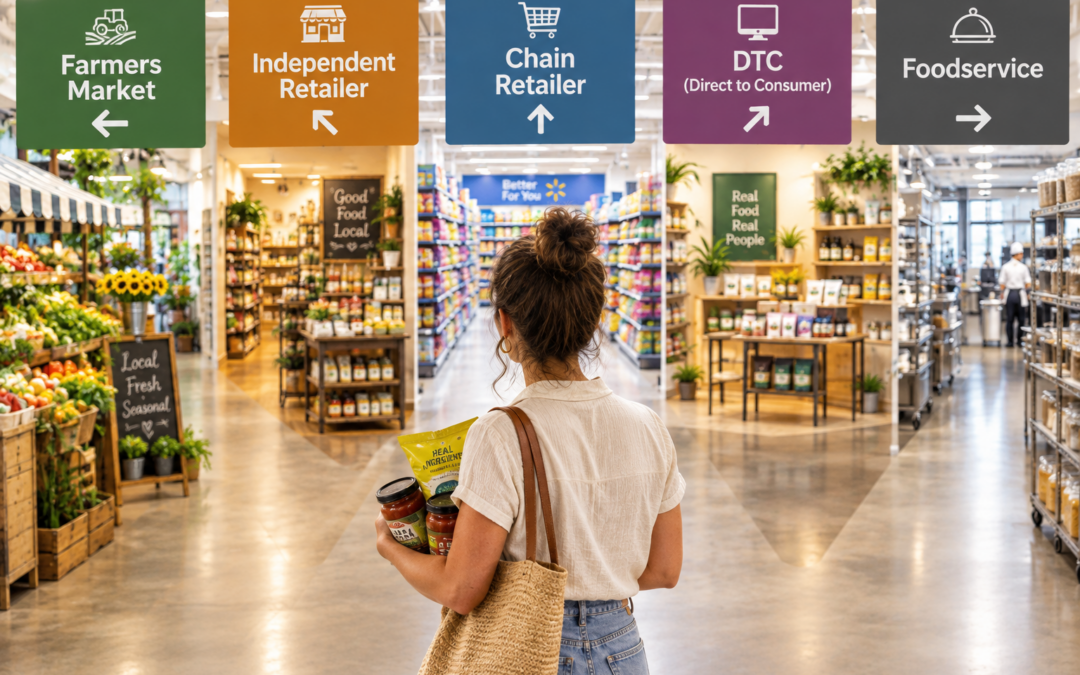
Founders treat channel like a ladder. That’s the wrong metaphor. Farmers market, then independent retail, then chain, then maybe DTC on the side. It’s not a ladder. It’s five different businesses, each with its own capital requirements, margin math, and timeline to a check that clears.
So before you pick one, run it through four questions.
Four Key Channel Questions To Start
Before you chase a channel because it sounds impressive, sit down and answer these four questions honestly.
1. Capital. How much cash can you deploy before you need to see a return? Every channel asks for money in a different form: a tent and a card reader, a slotting fee, an ad budget. The honest answer here rules out more channels than any branding decision ever will.
2. Margin. What’s your true gross margin after trade spend, freight, and labor? Not the number on your cost sheet before you subtract those. The number that’s actually left once a case ships and sells.
3. Time. How much of your own time can you give to selling, and how much do you need to pay someone else to do? Some channels run on relationships a founder builds personally. Others run on capital that buys someone else’s time instead.
4. Shelf Life and Temperature. Is your product shelf-stable, refrigerated, or frozen? Does it last for months or days? Temperature and shelf life change your freight costs, your storage costs, and how much room a retail buyer has to be wrong about how fast you’ll sell.
Start Here
| If this describes you… | Start with… |
| Thin capital, want to learn fast before spending real money | Farmers Markets |
| Strong margin, thin capital, willing to build relationships store by store | Independent Retail and Foodservice |
| Real capital and a margin cushion already built | Chain Retail |
| Outside investment and a real marketing skill set and $50 or high retail price point for average order size. | DTC |
| Refrigerated, frozen, or short shelf life product | Same channel as above, with a significantly higher margin bar |
Farmers Markets: Cheap Data, Slow Scale
Farmers markets are the best low-cost lab a founder will ever have. You talk to real customers, watch faces when they taste the product, and quickly learn whether anyone will pay full price. The capital required is close to nothing: a tent, some product, a card reader.
The tradeoff is that farmers’ markets don’t scale on their own, and you can only be in one place at a time. They build a small, loyal fan base, not a distribution business. I’ve seen founders stay at the market stage two years too long because the weekly cash felt good and the growth felt real. It wasn’t growth. It was a very loyal, very small audience. Great for recipe testing, pricing, and packaging feedback. Not a revenue plan.
Independent Retail: The Long Apprenticeship
Independent grocers, specialty shops, and regional chains are where most food brands actually learn the business. Margins are more forgiving than big retail chains. Buyers are more accessible. You can walk into a store, talk to the owner, and get a yes in the same conversation.
I think about Don Sazon here, the seasoning company I profiled earlier this year. They built their business one independent Hispanic grocer at a time, meat market by meat market, before they ever had a national retail conversation. Their Taco Truck seasoning line is a hit in independent stores today, and every account along the way taught them something that prepared them for what came next.
The catch is that independent retail takes people. Someone has to deliver, merchandise, and manage relationships store by store. That’s a founder’s time or a broker’s fee, and neither is free. Without a route to run or the cash to pay someone else to run it, this channel eats your bandwidth faster than it grows your revenue.
Chain Retail: The Velocity Trap
Chain retail is the channel every founder secretly wants, and it punishes the underprepared fastest. Slotting fees, minimum order quantities, and trade spend show up before a single case sells. Then buyers want proof of velocity, meaning proof the product is already selling well, before they’ll commit real shelf space. You need sales to prove you deserve the shelf, and you need the shelf to get the sales.
If your margin can’t absorb slotting costs, demos, and the markdowns that come with a slow-moving SKU, a chain deal can damage the business even while it looks like a win on paper. I’ve watched founders celebrate a big placement and quietly go underwater six months later because nobody ran the math first.
Chain retail rewards founders who’ve raised real capital or built a margin cushion in independent retail first. It punishes founders who mistake the door opening for the finish line.
DTC: Control at a Cost
Direct-to-consumer flips the equation. No buyer to convince, no slotting fee, and you keep the customer relationship and the margin that would otherwise go to a retailer. It is hard to make money without AOV (average order value) over $50-75 dollars and an LTV (lifetime value) of at least two years.
But DTC has its own tax, paid in marketing dollars instead of trade dollars. Customer acquisition cost on Amazon or a branded Shopify site has climbed steadily, and the fees each platform takes on every sale have to get baked into your pricing too. Organic social is a good place to start, but you’ll want to test paid ads and a TikTok store once you’re ready to scale reach.
I know a shopper, my own wife, who buys one flavor of Kate’s Bar on Amazon and nothing else. She sampled it once, during some consulting work I did with the brand, and now the relationship lives entirely on a screen. That’s the DTC dream. But for every customer who finds you and stays, you’re paying to find someone new, over and over, without the foot traffic doing that work for free.
DTC suits founders with a real digital marketing skill set, a product people repurchase, and the patience to build a customer base one paid click at a time.
Foodservice: The Underused Shortcut
Foodservice gets ignored by first-time founders, and that’s a mistake. Selling into restaurants, food trucks, and institutional kitchens usually comes with lower trade spend, better per-unit margins, and a faster path to real volume.
Don Sazon again is the example. Millions in annual revenue came through foodservice before the retail side scaled. That volume built the manufacturing discipline and cash flow that made the retail conversation easier later, not harder.
I have some helpful information on Foodservice for CPG brands here.
Shelf Life and Temperature Change Math
Question four from the framework deserves its own explanation, because it quietly overrides everything else.
Don Sazon’s seasonings are shelf-stable, and that does a lot of work you don’t see. A jar can sit in a warehouse for a year, ship anywhere in a cardboard box, and land in a chain retail conversation without asking a buyer to solve a cold chain problem. Shelf-stable products carry the fewest constraints of any product type. They can move into every channel at once.
Refrigerated products carry a different set of costs before a single unit sells. Brands like Mid-Day Squares and Perfect Bar live in a different part of the store, reached by a different shopper in a different mindset, and every step of getting there costs more. Reefer trucks, refrigerated warehousing, a shorter runway before markdown. That usually means a refrigerated product needs a higher price point or a fatter margin to make the same channel math work.
Frozen sits in between. Freight and storage costs are real, but shelf life stretches out much further, sometimes six months or more. The tradeoff shows up in freezer case fees and lower foot traffic through the frozen aisle.
And short shelf life is its own constraint, separate from temperature. A two-week window, chilled or not, isn’t built for a sales cycle measured in months. That pushes short-shelf-life products toward local, high-touch channels: farmers markets, DTC with fast shipping, foodservice with frequent reorders, and independent accounts you can restock personally.
Other channels to consider include mass (Walmart/Target), but they are rarely a great starting point for a startup food brand. And of course, convenience stores may also be part of the conversation if your product fits that impulse-snack category too. And there are others – but I would start with the 5 discussed above.
Put It Together
Run your product through the four questions honestly, then look at the start here table again. The channel that sounds most exciting is often the one least matched to the capital, margin, time, and shelf life you actually have. Founders who build durable businesses start with the channel that fits today and earn their way into the next one.
Three Key Takeaways
1. Channel choice is a financing decision first, a marketing decision second. Before picking a channel, know your available capital, your true gross margin after trade spend, freight, and labor, and whether your product is shelf stable, refrigerated, or frozen. The channel that looks most prestigious is often the one least matched to the resources and the product you actually have.
2. Foodservice and independent retail teach the business before chain retail tests it. Building through independent grocers and foodservice accounts builds manufacturing discipline and cash flow first, and that foundation makes every later opportunity less risky.
3. DTC trades trade spend for ad spend, not for free. Selling direct keeps your margin and your customer relationship, but it requires a real marketing budget and the skill to run it. Without both, a grocery aisle will find you customers for free in a way a website never will on its own.
My Advice
You need a clear strategy for what you want to achieve, the time frame, and the financial resources. One of my clients, Lid Lickin’ BBQ Sauce, started year one to get into 100 independent stores across North Carolina. They wanted to do everything right, and that meant demos and sampling in as many locations as possible. They hit the goal. In year two, they set out to add another 100 stores, and they’ve already reached that goal. But they are focused on indepedent retail and doing most of the distribution themselves. This coming year, they experiment with DTC to learn.
By growing slowly through independent retailers, they built a more predictable business that fit with their finances and their business objectives.
If this feels overwhelming and you don’t have much experience making this call, schedule time to talk with me through my Calendly link. That first conversation is free, and it might be exactly what you need to get off to a strong start.
Connect with Jeff at The Marketing Sage Consultancy. Interested in setting up a call? Use my calendly to schedule a time to talk. The call is free, and we can discuss your brand, marketing needs, and challenges.
Feel free to email me at jeffslater@themarketing sage.com or text 919 720 0995. Thanks for your interest in working with The Marketing Sage Consultancy.