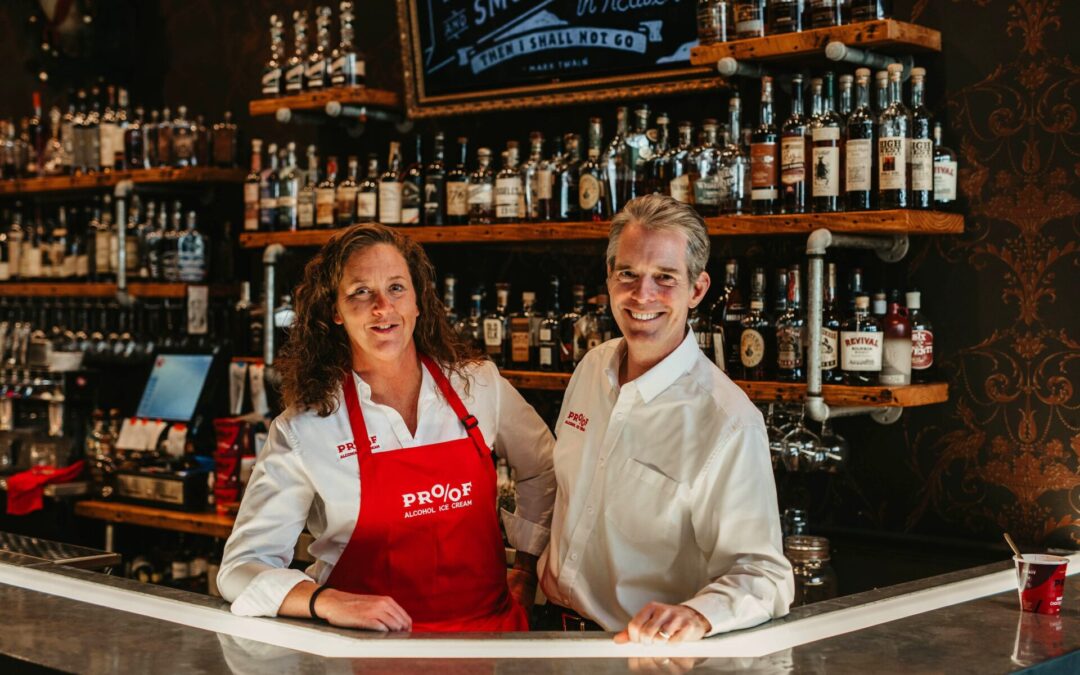
Jenn Randall and Dirk Brown Are Building PROOF Hard Ice Cream
Back in the late 1970s, my wife and I sold our brownies frozen. It was the only way an all-natural baked good could survive the trip from our Philadelphia kitchen to a convenience store counter. I quickly learned that frozen is hard. Freezer trucks cost more. Freezer space is tight. And every mile between your plant and the store is another chance for something to go wrong.
When I sat down with Jenn Randall and Dirk Brown, the co-founders of PROOF Hard Ice Cream, I got a sense of the mountain they were climbing. Then I remembered their ice cream also contains real alcohol.
In Olympic diving, judges score every dive on its degree of difficulty. A simple dive done well earns a decent score. A dive full of twists and somersaults earns more, if you can pull it off. PROOF picked one of the hardest dives in the food business. Frozen and alcohol. Two supply chains, two sets of rules, and very few partners who handle both.
And yet here they are, in more than 500 stores across seven states. Their story starts with a hand-crank ice cream maker in the Kentucky mountains.
A Kentucky tradition
Jenn grew up in Mount Sterling, Kentucky, a town of about 5,000 people and a couple of stoplights. Locals call it the gateway to the mountains.
In Kentucky, she told me, people put bourbon in just about everything. Truffles. Chocolates. Marinades. Cakes. Custards. So why not ice cream?
Jenn quickly says she didn’t invent the idea. Generations of mountain families made ice cream with a hand crank. When the ice cream froze too hard and the crank stiffened, someone would pour in a little bourbon or moonshine to loosen it. It didn’t add much of a kick. It just made the ice cream smoother and softer.
That small piece of family know-how became the seed of a business.
Jenn grew up without much. “We didn’t know we were poor, but we were poor,” she said.
She was also a heavily recruited basketball player. She chose the University of South Carolina, played there in the 1990s, and earned a degree in sport management. That degree included many business and marketing classes.
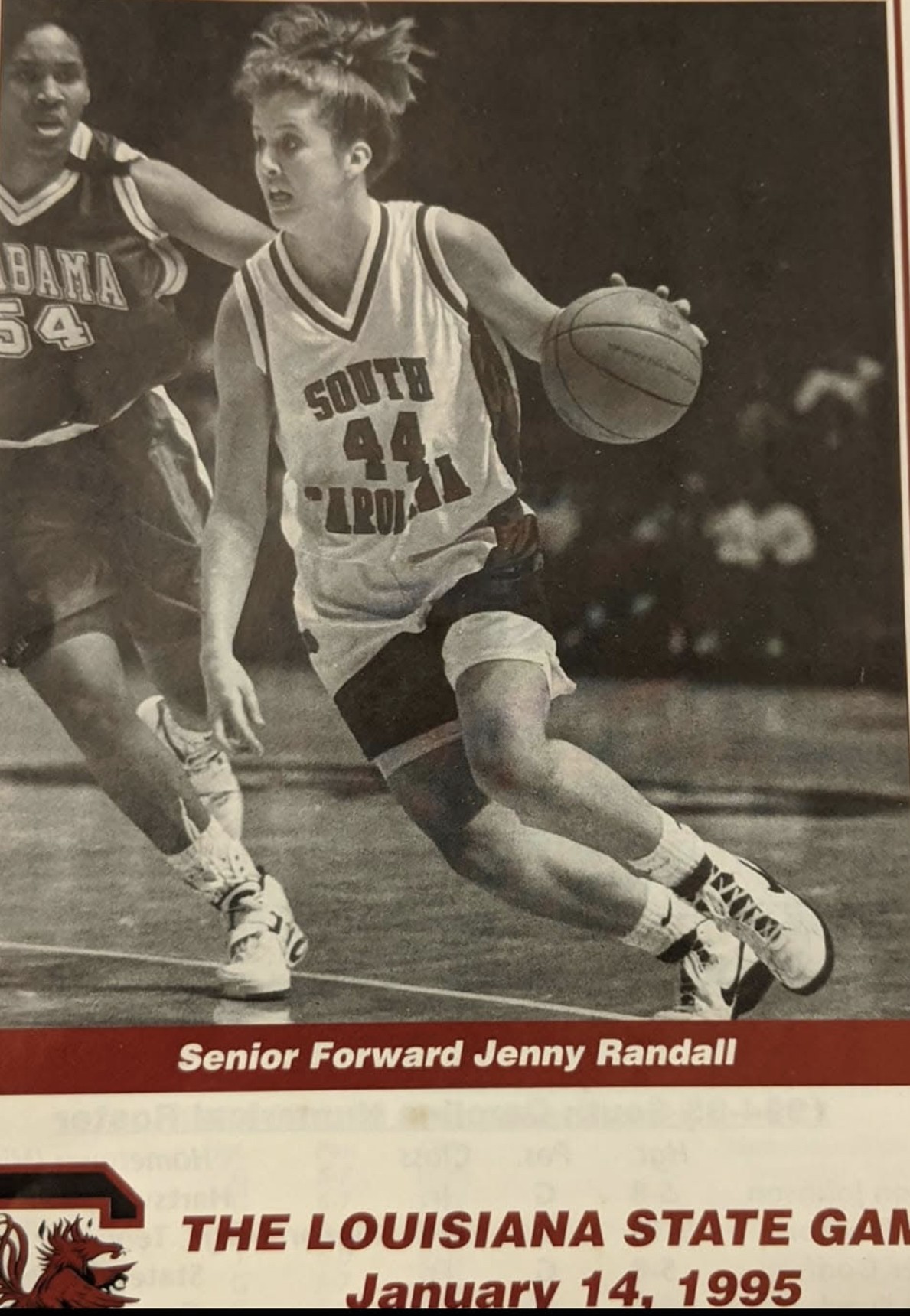
It proved very useful.
A single mom and a proof of concept
About a decade ago, Jenn spotted an opening. South Carolina had an old law, written years earlier for a Spartanburg bakery, that allowed alcohol in baked goods. It gave her a place to test her idea.
So she left a comfortable life in Kentucky and moved her kids to Columbia as a single mom to build a proof of concept. That takes real courage. It also tells you something about Jenn. When she believes in something, she commits.
She started small, running taste demos at restaurants and bars around South Carolina. The same thing kept happening. People tasted it and asked where they could buy it. That question told her she had a business.
The spoon that changed everything
Through one of his former students, Jenn met Dirk Brown. Dirk came to South Carolina from Silicon Valley, recruited by USC to run its entrepreneurship institute. He has a PhD in materials science from Cornell, worked in the semiconductor industry, and built a long string of tech startups. Ice cream was not on his radar.
Jenn handed him a spoon. “I don’t know what it is exactly, but I’m in,” Dirk remembers thinking. He became an early investor, then a board member, and eventually Jenn’s business partner.
Think about what that spoon did. Jenn needed someone who understood how to make alcohol behave inside a frozen product. Alcohol doesn’t freeze at ice cream temperatures. Add too much, and you get a slushy milkshake. The person who tasted her ice cream was a materials scientist.
Together, they figured out how to bind the alcohol to the dairy proteins so the ice cream stays smooth and creamy at 5% alcohol by volume, about the same as beer. Jenn calls it a real technical challenge, and they keep refining it. The binding method is closely guarded.
Here is the first lesson.
A great product is a magnet. Make something delicious, and the right people will find you.
Jenn has a simple motto. “Just get a spoon in their mouth,” she says. “Once people taste the product, everything else becomes easier.”
She has the proof. At a Kentucky wine and spirits show in late 2024, a four-hour tasting produced 40 new buyers and an opening order of more than $45,000.
Writing the rules
Next came the regulators.
This was a new product for federal regulators, so Jenn and Dirk worked closely with the federal Alcohol and Tobacco Tax and Trade Bureau to create a path. They had to become regulatory experts on top of everything else.
The lineup today reads like a cocktail menu. Sweet Caramel Old Fashioned and Chocolate Cherry Manhattan carry the bourbon flag. Chocolate Espresso Martini, Strawberry Daiquiri Spritz, Tropical Piña Colada, and New York Cheesecake Martini round it out. Three co-branded flavors with Luxardo, the Italian maker of the famous cocktail cherries, are on the way.
Straight to the grocery freezer
Most food startups follow a familiar path—farmers markets, festivals, restaurants, and then grocery. PROOF skipped ahead. In its first year, it landed Lowes Foods, followed by Total Wine & More and Harris Teeter. Florida came next, with Winn-Dixie and Walmart. Then Costco, SmartMart, Lucky’s, Festival Food, and Food Lion joined the list.
Retailers liked it for a simple reason.
It isn’t quite ice cream, and it isn’t quite alcohol. Shoppers didn’t swap it for a pint of Ben & Jerry’s or a bottle of wine. They added it to the basket.
The results back that up.
One Thanksgiving, PROOF ranked among the top five items in the wine category at Harris Teeter. At Save Mart in California, unit sales have surpassed major brands like Talenti and Baskin Robbins. A pint sells for $11.99 to $12.99, which Jenn sees as affordable indulgence. And because PROOF is an alcohol product, it can’t pay the slotting fees most food brands pay to get on the shelf. It earned its space.


Too much, too fast
Early success brings attention. PROOF drew interest and participation from seasoned, aggressive investors; senior industry executives; and large grocery chains with demanding service requirements. The focus was on brand building and consumer research, the classic CPG playbook. PROOF’s real bottleneck lay elsewhere. As Jenn put it, they got a little over their skis and spread themselves too thin.
As the company expanded, Jenn and Dirk recognized the need to prioritize operational efficiency and sustainable growth over rapid expansion.
Here is the double difficulty again.
Alcohol distributors don’t have freezer trucks. Frozen food distributors usually don’t have alcohol licenses. And the rules change by state.
PROOF built a patchwork that works. It self-distributes in the Carolinas and Florida. Third-party partners handle California and Wisconsin. Two brokers, one on each coast, help with retail sales.
Dirk was clear with me. PROOF doesn’t have the usual CPG problem of getting shoppers to notice. People buy it. The growth challenge is servicing those accounts well. He also sees a silver lining. The same barriers slowing PROOF down will make it very hard for anyone to follow. In fact, it has opened up several exciting partnerships.
Choosing focus over footprint
About 30 other states have come calling. It would be easy to chase them all. Instead, Jenn and Dirk are tightening their focus on the states they already serve and growing deeper there.
The next step is what they call model markets.
The idea is to build demand in a few dense areas through paid trials wherever people gather. They have already served 100 ml cups at NASCAR events at Darlington Raceway and at Summerfest in Milwaukee. They have sampled with the Milwaukee Brewers and are sponsoring Barrett-Cope Racing in NASCAR. Picture someone trying PROOF at a ballgame, then spotting it in the freezer at their local grocery store the next week.
They are also exploring food service, cruise lines, and military commissaries. New relationships are opening those doors.
I met Jenn and Dirk through Jonathan Marcus, an investor and strategy and growth expert specializing in emerging CPG brands. Jonathan believes in the brand and joined the company as its Executive Vice President of Corporate Strategy and Growth, working to open doors in food service and on military bases, among many other expansion initiatives.
To fund the next stage, PROOF is raising capital through a crowdfunding campaign on Wefunder (wefunder.com/proof.hard.ice.cream), giving fans a chance to own a scoop of the business.
The right helpers at the right time
What strikes me most about PROOF is how the business has grown through people. Each stage needed a different kind of help.
Early on, a scientist could solve chemistry issues.
Then regulators were willing to work through a brand-new category.
The leadership bench has evolved too. Mark Brodeur, a former Nestlé executive, now leads operations. The advisors include Dreyer’s and Diageo alums. In other words, people who know ice cream and people who know spirits. That is exactly the mix a double-difficulty business needs.
Some helpers bring operating experience.
Others bring a spotlight. R&B artist October London is now an investor, a business partner, and PROOF’s Chief Creative Advisor. He highlights the partnership at his concerts, encouraging fans to support the product with video footage and testimonials on stage.
Earlier this month, he joined the team for a PROOF event and sat with the press and the founders to discuss his passion for this product and this team. He’s now repeating that moment at his shows nationwide. The partnership has caught the attention of Men’s Journal, Yahoo News, and other outlets.
But this is more than a celebrity endorsement.
In October, London is rolling up his sleeves on business and corporate development, helping open doors a small company in Columbia, South Carolina, might never reach on its own.
Jenn believes in failing fast, learning from it, and building on it. That mindset has helped her treat every misstep as tuition rather than defeat.
The common thread is the product.
Nearly every one of these relationships started because someone tasted it.
Three Key Takeaways From My Conversation with Jenn and Dirk
- Make something worth tasting, then share it generously. One spoonful turned a Silicon Valley scientist into an investor and partner. One four-hour tasting turned into 40 new buyers. Your product can be your best recruiting tool.
- Match the helper to the problem. Big résumés are impressive, but the most valuable advisors know your exact challenge, whether that’s a channel, a regulation, or a supply chain.
- Go deep before you go wide. When thirty states want you, the smart move is to say “not yet” and win where you already are.
Back in Mount Sterling, a little bourbon kept the crank turning.
Today, the right people are doing the same for PROOF. Jenn chose one of the board’s hardest dives.
With the right team on the platform, I like her chances of making a big splash.
Connect with Jeff at The Marketing Sage Consultancy. Interested in setting up a call? Use my calendly to schedule a time to talk. The call is free, and we can discuss your brand, marketing needs, and challenges.
Feel free to email me at jeffslater@themarketingsage.com or text 919 720 0995. Thanks for your interest in working with The Marketing Sage Consultancy.