
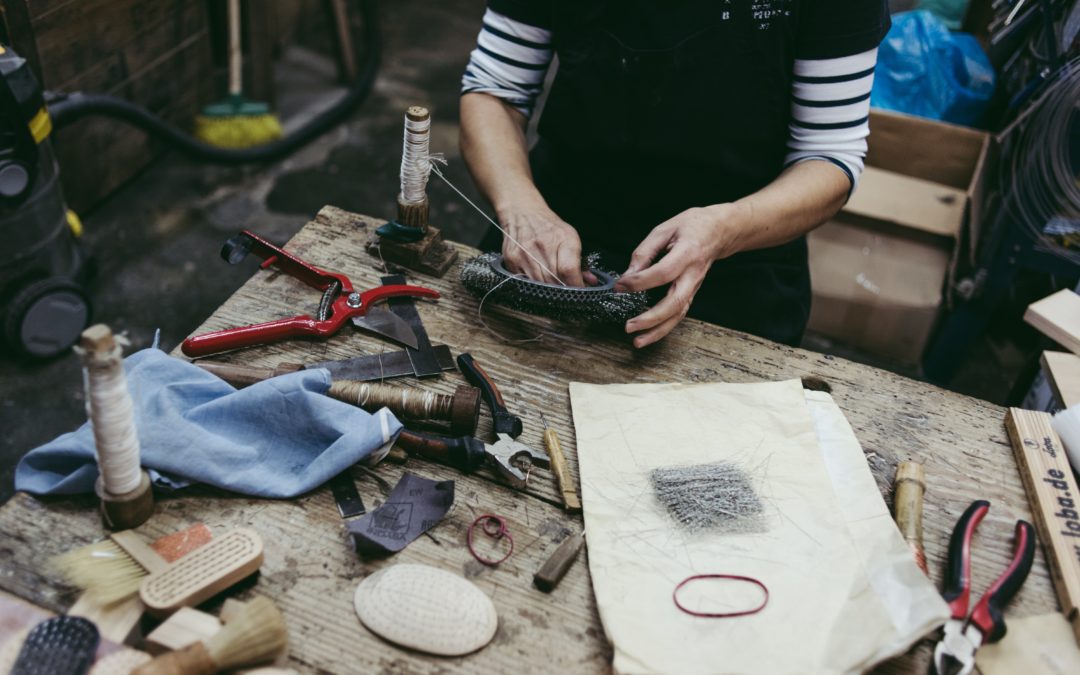
Rapid prototyping of an idea always intrigued me. Whether it was a new product, a service or a concept – how can I make the design idea in my head, something that you could hold in your hand? What are the ways that you can help others see your vision? Prototyping a product or service allows you to visualize and touch the experience, even if it is just in a rough, draft format.
Sometimes the most uncomplicated prototypes are through images that help someone understand the emotional connection behind a product. I have used photographs projected on a screen to help stimulate the feelings and emotions of an idea – almost like a vision board.
You can do simple prototypes like an arts and craft project with the most basic materials. With some extra fabric, tape, paper, and glue – you can take your idea and take the concept within your head into someone’s hand.
The benefit in making a prototype is that the idea becomes real.
Even software can be prototyped using human interaction. I was listening to the Ideo podcast recently, and they were discussing how when faced with designing a new type of ATM, they had a person give verbal responses to demonstrate the idea of a new kind of interactivity. They rigged up an iPad with a few buttons and with a person in another room, it mimicked how the device would work. Instead of wasting weeks on technology, they just hacked the idea to demonstrate what the user would experience.
I always bring an early prototype to every status meeting I have with one of my clients. Having participants hold, play and touch the object we are working on, makes this activity less cerebral and much more tangible. As we talk about the need to spend money on upcoming milestones, there is a confidence-building from being able to see progress and hold the early-version of an idea in your hand.
Six Tips for Prototyping Services
Ideo offered six tips for prototyping a service. Here are my thoughts on each stage.
- The moment that matter. Focus on that one point in a user’s journey that can make a critical difference. What do they love, what frustrates them, what delights them? Emphasize that moment that counts. Not every step is of equal importance, so pay attention to the moments that matter most.
- Watch for early indicators. When you share crude prototypes with users, often you’ll quickly identify that you are on a wrong path. You are solving a problem that isn’t primary to the experience. The faster you prototype, the quicker you can be on the right track. Use the process to quickly get feedback if your approach is touching the right note.
- Tap into the front line. Those who currently deliver products or services to the community you want to serve can remind you of the wisdom they hear all the time. For example, nurses in elderly clinics know how aging patients might tell you that they can’t open the jars by themselves so your prototype could benefit from feedback from those who live with the experience daily.
- Use time-based moments. Engagement with products and services happen over time. The company that makes returning goods simple can win because they focused not just on the product, but how to make the client’s happy. I love it when shipping a return is easy and well-designed. Think about the various moments over time in prototyping and where you can bring a new solution.
- Imagine an idealized version. A crude prototype can help people (clients, prospects, others) to identify critical needs that are missing. A zipper that is too short or font that is too small can be a valuable clue on a rough prototype of a product. Recognize you don’t have all the answers and some of the gaps come from those you want to serve and sell. It always strikes me that shampoo and conditioner bottles should use LARGER FONTS since most people don’t wear their glasses in the shower and need help seeing which bottle they grabbed.
- Impose constraints to go deeper. What if you could only use people to deliver your message. Or, what if you only used signs or icons? By adding constraints, you can do some great work exploring elements and dimensions of what you want to create. By providing artificial limits, you can often find innovative solutions to a challenge.
If you’d like to learn more about prototyping services through Ideo’s model, check out this PDF. And like me, you are fascinated with design thinking and the creative process, learn more about the great work IDEO does to help clients create better experiences.
If you are working on a new service offering or product launch, start early by bringing the idea to life, even if it’s crude and simplistic. Get out your scissors and glue and mock something up.
Photo by Kelvyn Ornettte Sol Marte on Unsplash
You can set up a time to chat with me about your marketing challenges using my calendar. Email me jeffslater@themarketingsage.com Call me. 919 720 0995. Visit my website at www.themarketingsage.com The conversation is free, and we can explore working together.