

When The Ordinary launched under the DECIEM Company umbrella, it felt like a small, sharply focused rebellion against the beauty category.
DECIEM was a multi-brand beauty incubator. Instead of focusing on one line, it launched multiple brands at once, all rooted in science, transparency, and in-house formulation. Its most famous brand, by far, is The Ordinary, which has become a global hit. Other DECIEM brands have included:
NIOD, Hylamide, The Chemistry Brand, and The Ordinary (by far the largest)
Our approach was to cut out the superfluous and create high-quality products. Backed by scientific research, we embraced a no-nonsense aesthetic and simple product names that clearly identify the active ingredients.
Nicola kilner
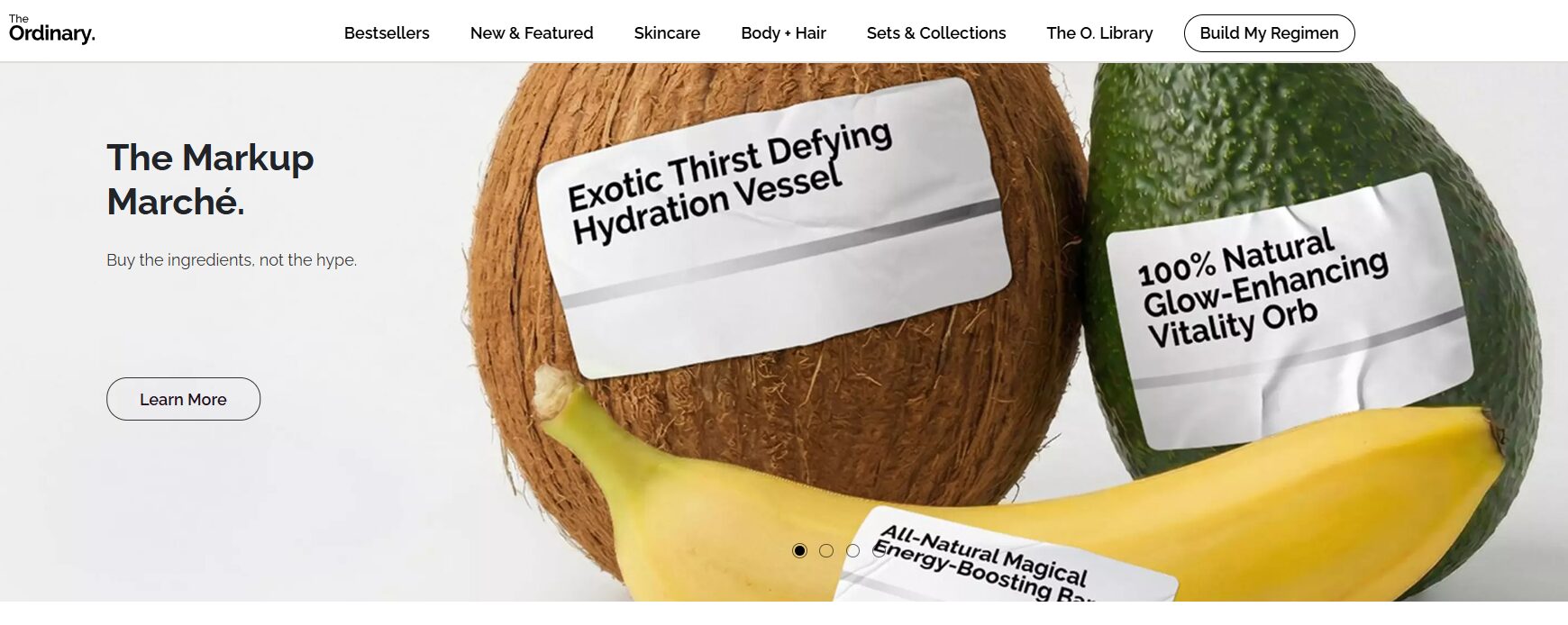
Instead of glossy promises, celebrity packaging, and vague claims, The Ordinary offered clear ingredient callouts, clinical-looking labels, and prices that felt almost confrontational. That mix of utility, transparency, and affordability turned what could have been a niche lab brand into a global phenomenon.
This post examines the brand and marketing strategy behind The Ordinary, sketches the founders and ownership arc, offers an estimate of 2025 volume, explains their enemy and positioning, and closes with three practical takeaways for brand builders.
Origins and the founders
DECIEM was founded in 2013 by Brandon Truaxe and Nicola Kilner.
Truaxe brought a contrarian streak and a tech-like obsession with product formulation.
He launched multiple brands at once with a stated mission to demystify beauty and to expose the industry’s markup mechanics. Nicola Kilner functioned as the operational and strategic counterpart, helping scale the organization into a multi-brand, vertically integrated operation.
The Ordinary debuted as the accessible, ingredient-first line that distilled that mission into a single visual and verbal idea: call the product by its active, show the percentage, and let the efficacy speak.
The company’s early years were chaotic and dramatic, and the brand survived leadership turmoil and the founder’s tragic death.
Eventually, DECIEM drew strategic investment, and in 2024, the Estée Lauder Companies completed the acquisition of the group. These milestones matter because they show how a disruptive positioning can be institutionalized at scale.
What makes The Ordinary unique: the Positioning
The Ordinary appears to compete on price and clinical efficacy.
That is correct but incomplete.
The deeper strategic insight is that The Ordinary used authenticity and transparency as an organizing brand idea.
Rather than framing competitors as using impure ingredients, The Ordinary framed the broader industry as guilty of obfuscation, hyperbolic claims, and cosmetic storytelling that hid the fundamental value proposition.
In short, their enemy was not chemistry.
Their enemy was inauthentic marketing and the category’s habit of selling beauty via aspiration rather than clear information.
The Ordinary inverted that script. It presented straightforward typography, plain bottles, and ingredient-first names to signal honesty and to empower the consumer with knowledge rather than persuasion.
This positioning created three seismic advantages.
- First, it lowered purchase friction by making product choice easier.
- Second, it built trust among skincare enthusiasts who value measurable actives.
- Third, it turned the brand into a conversation starter for influencers, editors, and online communities who could discuss percentages and compatibility rather than vague benefit claims.
Packaging and visual system
Packaging is where strategy meets signals.
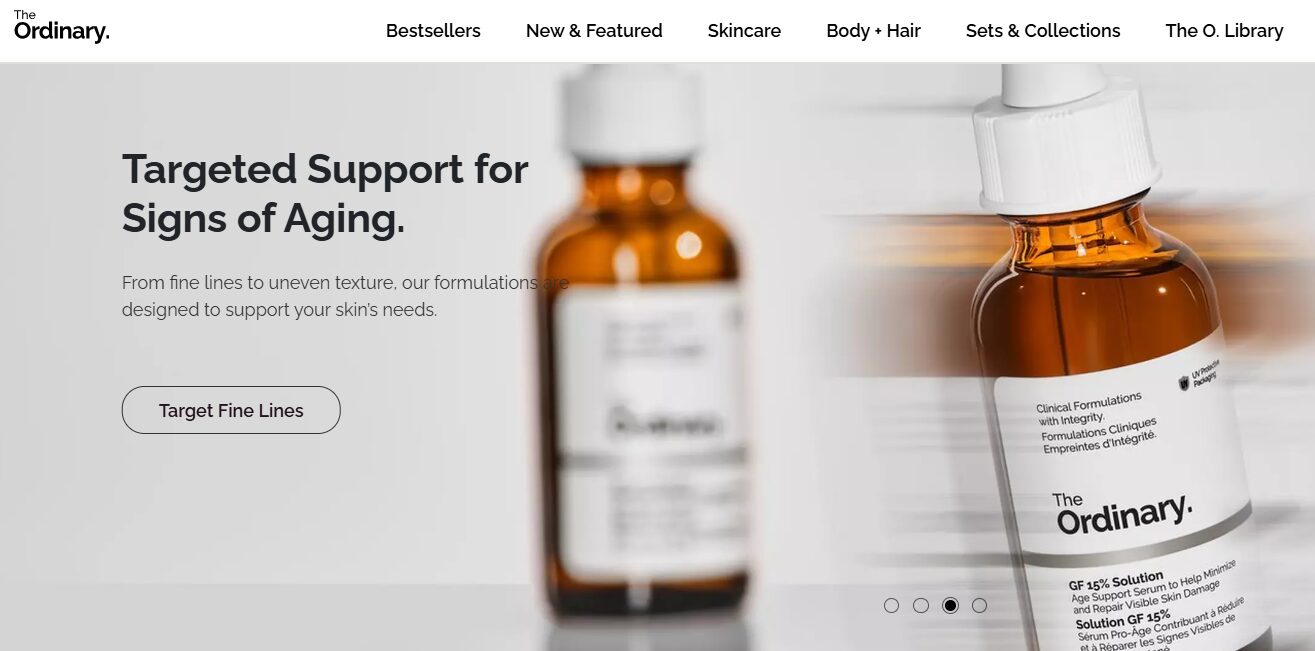
The Ordinary’s lab-white boxes, clinical typography, and minimal labeling communicate science and seriousness.
That aesthetic also serves as visual shorthand on crowded shelves and small screens. While other brands fight for attention with color and photography, The Ordinary relies on legibility and a neutral grid.
The minimalism performs double duty. It reinforces the ingredient-first messaging, and it reduces perceived overhead, making price-point claims feel credible.
The simplicity is not accidental.
It is a deliberate brand lever that signals utility, positions the product alongside clinical or pharmacy brands, and streamlines content generation for social channels.
Distribution and channels
The Ordinary built its initial momentum through direct-to-consumer channels and DECIEM’s own stores.
As demand scaled, it expanded into mass and specialty retail partners, including major beauty and drugstore channels. Strategic retail placements amplified reach while keeping the brand accessible.
The combination of DTC and broad retail availability helped the brand control storytelling online while benefiting from discoverability in physical stores
.
2025 volume and scale (estimate)
Estimating volume for a private business that a public conglomerate now owns requires caution.
Public-facing sales data for the brand alone is scarce. Still, marketplace and online sales trackers suggest The Ordinary’s own e-commerce business generated north of hundreds of millions in annual gross merchandise value in recent years.
Conservative projections based on baseline and modest growth expectations place 2025 online volume in the low double-digit percentage increase range versus the prior year.
Put differently, the company operates at an accurate mass-market scale rather than at boutique, niche levels, and drives hundreds of millions in sales across channels.
That fact explains why large strategic investors were willing to consolidate ownership.
Competitors and category dynamics
The Ordinary’s success invited an immediate wave of lookalikes.
Brands such as The Inkey List, Good Molecules, Versed, and established players like Paula’s Choice and CeraVe compete on transparency, price, and ingredient clarity.
Each competitor takes a different angle.
Some focus on more explicit consumer guidance and ritualization. Others emphasize dermatologist endorsement and distribution in mass pharmacy channels. The competitive set pushed the category toward a new norm in which ingredient disclosure, clinical claims, and accessible price points are baseline expectations.
How social media built the brand
Social platforms accelerated The Ordinary’s rise because the brand’s product architecture is inherently shareable.
Single-ingredient narratives and measurable concentrations give creators content hooks that are easy to explain and compare.
The brand leaned into educational content, user-generated reviews, and community debate.
Forums and social networks turned serums into conversation topics and earned coverage from editors and influencers, amplifying that effect. The Ordinary’s minimal packaging helped here, too.
It reads well in short-form video and in editorial close-ups, and the brand leaned into community Q&A rather than aspirational celebrity storytelling.
Risks and limitations
The Ordinary’s stripped-back identity is not a silver bullet.
Minimal packaging can be perceived as clinical or austere depending on the audience. The ingredient-first approach can intimidate beginners who want a guided routine. Increased competition has led to price compression and a crowded aisle of similar propositions. Finally, scale brings operational complexity.
A brand built on radical transparency must maintain control over its supply chain and consistent product quality to avoid betraying the trust that underpins its positioning.
Three learnings for brand builders
- Build an enemy you can own. The Ordinary did not merely oppose high prices. It opposed obfuscatory marketing. That choice allowed the brand to create a clear cultural contrast with incumbents and appeal to consumers who wanted an honest alternative.
- Make your product architecture the content engine. When the product itself supplies simple, repeatable talking points, the community will do your creative work. The Ordinary’s ingredient-first naming convention turned every product into a content module that creators could explain, compare, and recommend.
- Design for clarity and context. Minimal packaging does more than look good. It communicates positioning, reduces perceived overhead, and optimizes for the small-screen attention economy. But clarity must be matched with education. If your product signals expertise, provide the how-to education to make that expertise usable for customers.
The Ordinary is Extraordinary Because of Discipline
The Ordinary is a modern case study in how a coherent idea, executed consistently across product, packaging, price, and community, can rewire a category.
It did not win because it offered a discount. It won because it made honesty and ingredient literacy into a brand and a movement.
For marketers, the lesson is simple.
A disciplined enemy, a product truth that informs content, and a visual system that signals that truth can become the kernel of a powerful, scalable brand.
Connect with Jeff at The Marketing Sage Consultancy. Interested in setting up a call? Use my calendly to schedule a time to talk. The call is free, and we can discuss your brand, marketing needs, and challenges.
Feel free to email me at jeffslater@themarketing sage.com or text 919 720 0995. Thanks for your interest in working with The Marketing Sage Consultancy.