
How CPG Retail Food Brands Unlock Million-Dollar Foodservice Revenue Streams
Making money in the retail food landscape has become wildly challenging for consumer-packaged goods brands and startup entrepreneurs.
Rising slotting fees, intense promotional pressure, and razor-thin margins have left many CPG companies searching for alternative revenue streams that can stabilize their business and improve overall profitability. Retailers are copying successful consumer brands with private-label knockoffs.
What’s the alternative?
For some brands, the answer may lie in the foodservice industry.
This channel operates on fundamentally different economics and can provide the volume and efficiency gains that struggling retail brands desperately need.
Foodservice is Different
For most retail CPG brands, every sale represents a single transaction with an individual consumer. A jar of sauce, a bag of cookies, or a frozen entree moves from shelf to shopping cart one unit at a time. The cumulative effect of these individual purchases determines success or failure in the retail channel.
Foodservice operates on an entirely different scale. A single sale to a restaurant chain, hotel group, airline, or institutional foodservice operator can represent thousands or even millions of servings. This fundamental difference in sales dynamics creates opportunities that many retail brands overlook or underestimate.
The manufacturing efficiency gains from foodservice volume can transform a brand’s cost structure. When production increases from a few thousand units to hundreds of thousands, the economics shift significantly. Fixed costs are spread across more units, purchasing power for ingredientsimproves, and labor efficiency increases. For brands working with co-packers, larger volume commitments often unlock better pricing tiers and preferential treatment in production scheduling.
These cost reductions benefit not only the foodservice side of the business. They flow through to the entire operation, improving margins on retail products as well.
Ed Zimmerman is one of the leading experts in foodservice marketing. He is the founder of The Food Connector, based in Northern California. We met in the 1980s when my wife and I were building Rachel’s Brownies, and Ed worked for a competitor, Ms. Desserts, as VP of Sales and Marketing. I have a habit of befriending my competition, because I know I can always learn from them.
Ed sees this channel diversification as essential for modern CPG brands exclusively focused on retail:
“Too many retail brands wait until they’re in crisis mode before exploring foodservice, but the smart move is building that channel when you’re still healthy in retail. Foodservice isn’t a fallback position; it’s a strategic growth lever that changes your entire cost structure and risk profile. The brands I work with that have cracked the code on multi-channel distribution are consistently more profitable and more attractive to investors or acquirers because they’ve built resilient business models that aren’t dependent on a single channel’s economics.”
ED ZIMMERMAN, FOUNDER OF THE FOOD CONNECTOR
The most successful food brands today are channel agnostic. They understand that different channels serve different purposes in their portfolio strategy, and foodservice can provide the volume base that makes the entire business model work. This perspective represents a significant shift from the traditional view that positioned retail and foodservice as separate, sometimes competing channels.
Rachel’s Brownies: Selling Through Multiple Distribution Channels
My experience with Rachel’s Brownies, the bakery business my wife started in 1975, illustrates how foodservice can revitalize a brand facing retail challenges.

For approximately five years, we focused exclusively on retail distribution, building relationships with specialty food stores and small local natural food outlets. In the 1980s, we expanded to convenience stores, such as Wawa in the Philadelphia area, and later to grocery chains like Publix and other higher-end stores.
The business was stable and growing, but margins were perpetually under pressure. Convenience stores were easier for us, but expanding into larger grocery chains proved extremely challenging. And of course, we were clueless as this was our first food venture.
Slotting fees, trade spending, and the constant need for promotional support made profitability elusive despite strong consumer response to our products. We were producing extraordinary brownies that customers loved, but the economics of retail distribution were working against us.
The breakthrough came when we started exploring airline and commercial foodservice opportunities.
One day, we received a call from Carl Battista, a food buyer for United Airlines. He had wandered into a Wawa and fell in love with our brownies. That was our lucky day.
I remember him asking if we could sell him a million brownies in Q4. Of course, I said yes.
I was clueless about how we would do it.
The key takeaway was that we discovered the same products we were selling in retail, when packaged differently and positioned for foodservice applications, could command better margins while generating significantly higher volumes per customer.
There are trade spending requirements. But it is structured quite differently from retail.
An airline catering contract represented more volume than hundreds of retail stores combined. Corporate cafeteria operators and hotel food and beverage directors appreciated our quality and differentiation, but they required different packaging formats and ordering processes than those used in retail.
This wasn’t about creating entirely new products. We leveraged our existing recipes, brand equity, and production capabilities, but adapted the packaging and go-to-market approach for a different channel.
The volume from foodservice accounts allowed us to negotiate better ingredient pricing and achieve more efficient production runs. Notably, these efficiency gains also improved our cost structure for retail products, making us more competitive in that channel, even as we diversified our revenue base.
A Familiar Pattern
Zimmerman sees this dynamic repeatedly in the brands he advises:
“When a company builds foodservice thoughtfully, it creates a structural advantage that retail alone can’t deliver. The extra volume sharpens operational discipline, boosts efficiency, and makes the brand far more resilient. Foodservice doesn’t just support the business; it strengthens every other channel you operate in.”
ED ZIMMERMAN, FOUNDER OF THE FOOD CONNECTOR
Consider the trajectory of Perfect Bar, a refrigerated bar brand that built its reputation in natural food retail. After establishing itself in stores like Whole Foods, the company recognized that its fresh, refrigerated products had natural applications in foodservice settings, where freshness and high-quality ingredients commanded premium positioning.
They developed foodservice-specific packaging and began selling into corporate cafeterias, universities, and healthcare facilities. The foodservice channel now represents a meaningful portion of their business and has helped them achieve the scale necessary to expand their retail distribution into conventional grocery chains.
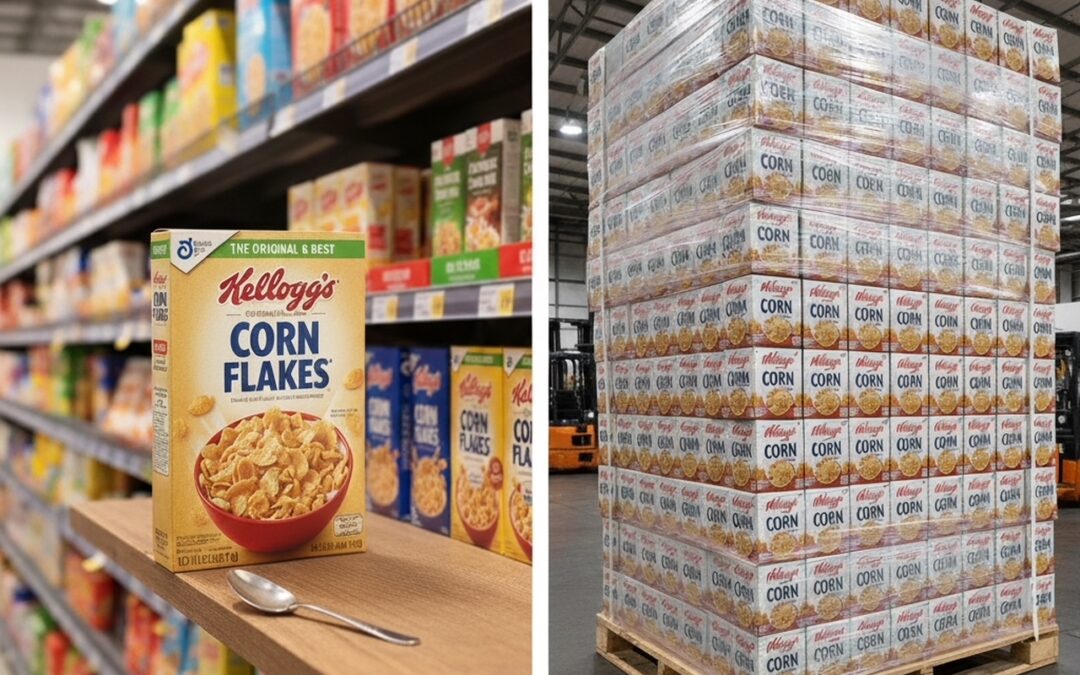
Another example is Kellogg’s partnership with foodservice distributors to place their retail cereal brands in hotel breakfast buffets, senior living facilities, and healthcare institutions. Rather than creating entirely separate products, they developed bulk packaging formats of the same cereals that consumers are familiar with from retail shelves. This strategy reinforced brand recognition while generating substantial volume that helped maintain manufacturing efficiency during periods when retail sales faced pressure from private label competition and changing breakfast habits.
Lesser Evil has also successfully balanced retail and foodservice channels with its better-for-you popcorn products. The brand established itself in both natural and conventional retail before recognizing opportunities in workplace snack programs, entertainment venues, and boutique hotels that sought premium snack options.
Ed Zimmerman adds perspective on this shift:
“What I keep telling emerging brands is that foodservice buyers today want the same premium, clean-label products consumers choose in retail. If your brand stands for quality, that value is consistent across all channels. Foodservice isn’t a down-market play; it’s an amplification strategy for the right kind of product.”
ED ZIMMERMAN, FOUNDER OF THE FOOD CONNECTOR
The Foodservice Landscape: So Many Opportunities
The breadth of foodservice channels offers multiple entry points for CPG brands:
- Quick Service Restaurants (QSR) – Fast food chains like McDonald’s, Subway, Chick-fil-A
- Full-Service Restaurants – Casual dining, fine dining, and family-style restaurants
- Fast Casual – Higher-quality quick service like Chipotle, Panera Bread, Sweetgreen
- Hotels & Lodging – Hotel restaurants, room service, banquet facilities, continental breakfasts
- Healthcare & Senior Living – Hospitals, nursing homes, assisted living facilities, medical centers
- Education – K-12 schools, universities, college dining halls, cafeterias
- Business & Industry (B&I) – Corporate cafeterias, employee dining facilities, office catering
- Military – Military bases, commissaries, mess halls
- Recreation & Entertainment – Sports venues, theme parks, movie theaters, concert halls, casinos
- Travel & Transportation – Airports, train stations, cruise ships, airline catering
- Corrections facilities (prisons, jails)
- Contract caterers (companies like Aramark, Sodexo, Compass Group that serve multiple segments)
- Convenience stores with foodservice (Wawa, Sheetz, 7-Eleven hot food programs)
Each channel has unique purchasing patterns, volume requirements, and menu needs that CPG brands can target strategically to optimize their sales. And not every channel will be right for every product category.
Considering Foodservice?
The operational considerations for entering foodservice differ significantly from those in retail. Product specifications may need adjustment for how foodservice operators will use the product. Packaging must withstand different handling and storage conditions. Sales cycles are longer, and building relationships with distributors and operators requires patience and persistence.
However, these barriers to entry also create competitive moats once relationships are established. Foodservice customers value consistency and reliability, and switching costs are higher than in retail, where consumers can easily try a different brand.
Brands considering foodservice expansion should start by identifying which of their existing products have the most natural fit for foodservice applications. Products that are already portion-controlled have a decent shelf life, and align with current foodservice trends such as health, sustainability, or ethnic flavors tend to have an easier path to adoption.
Working with foodservice distributors who already have established relationships with target operators can significantly accelerate market entry compared to attempting direct sales to individual foodservice locations.
The diversification benefits extend beyond just revenue and efficiency. Foodservice channels often exhibit different seasonal patterns than retail, which helps smooth out cash flow throughout the year. They also provide valuable consumer insights, as foodservice operators offer direct feedback about how products perform in real-world usage situations. This intelligence can inform retail product development and help brands stay ahead of evolving consumer preferences.
In an increasingly competitive food industry where retail margins continue to face pressure, CPG brands cannot afford to ignore the strategic and financial benefits that foodservice channels offer. The most successful brands will be those that view their business holistically, leveraging the strengths of each channel to build more resilient, profitable companies positioned for long-term growth.
Three Key Takeaways
1. Start exploring foodservice before you’re in crisis mode. The brands that succeed in building multi-channel distribution are those that expand into the foodservice sector. At the same time, their retail business remains healthy and stable, waiting until retail margins collapse makes the transition more difficult and limits their negotiating power with foodservice partners.
2. Foodservice volume transforms your entire cost structure. The manufacturing efficiencies gained from large foodservice contracts don’t just benefit that channel; they also flow through to improve margins on your retail products. This creates a compounding advantage that makes your entire business more competitive and profitable.
3. Work with experienced foodservice guides who know the territory. The foodservice channel operates with different dynamics, relationships, and requirements than the retail channel. Seeking out experts like Ed Zimmerman of The Food Connector, who can act as sherpas into this world, can dramatically accelerate your success with innovative marketing efforts and help you avoid costly mistakes. Their established relationships with distributors and operators, combined with deep channel expertise, can be the difference between a foodservice strategy that struggles and one that transforms your business.
If you need help navigating this, please reach out, and I’d be happy to share what I have learned from my retail-to-foodservice journey. And I’ll bet Ed would be glad to join a conversation, too.
Connect with Jeff at The Marketing Sage Consultancy. Interested in setting up a call with me? Use my calendly to schedule a time to talk. The call is free, and we can discuss your brand and marketing needs.
If you want to learn more about my new offering, The Trusted Advisor Board, you can click here to learn the details. Feel free to email me at jeffslater@themarketing sage.com or text 919 720 0995. Thanks for your interest in working with The Marketing Sage Consultancy.
Would you like to read some testimonials about my work? Click here.