

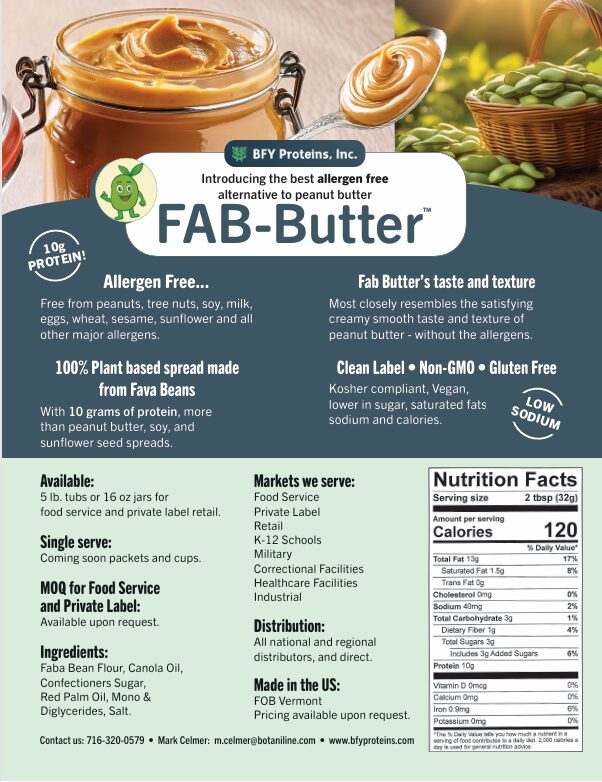
When entrepreneur Mark Celmer and his business partner, Dean O’Brien, set out to create FAB Butter, they weren’t just developing another food product—they were solving one of the most pressing safety challenges facing America’s schools today. Kids love peanut butter but more and more schools are banning it due to allergen issues.
The solution is Better For You Proteins.
With his deep understanding of institutional foodservice needs, Celmer recognized that schools desperately needed a peanut butter alternative that didn’t compromise on taste, nutrition, or safety. The current options weren’t cutting it with kids and he created a product that is free of the nine major allergens.
The result is FAB Butter, a faba bean-based spread that’s positioning itself to revolutionize school nutrition by replacing peanut butter in K-12 institutions across the United States.
And Mark has invested in the critical science and research behind going from faba bean to market.
But what makes this story particularly compelling from a brand strategy perspective is how Celmer and his team at BFY Proteins have demonstrated the power of laser focus and strategic channel selection in disrupting an established category.
Mark Celmer’s background brings a unique perspective to food innovation, having spent his career successfully navigating corporate turnarounds across healthcare, manufacturing, and now food science. As Co-Founder and CEO of BOTANILINE since 2018, Celmer has demonstrated his ability to build companies from the ground up and position them for long-term success. He has assembled an impressive team of experts to help guide the BFY Proteins endeavor.
The Job to Be Done: More Than Just a Spread
To understand FAB Butter’s potential for success, we need to examine the “job to be done” that schools are hiring this product to perform.
The Jobs to be Done (JTBD) model, developed by Clayton Christensen, focuses on understanding what specific “job” customers are trying to accomplish when they purchase a product or service, rather than just analyzing customer demographics or product features. This framework helps businesses innovate by identifying the underlying needs and desired outcomes that drive customer behavior.
On the surface, schools need a protein-rich spread for sandwiches and snacks. But dig deeper, and the real job becomes clear: schools need a solution that eliminates liability risk while maintaining student satisfaction and nutritional standards.

Traditional peanut butter creates a dangerous paradox for schools. It’s beloved by children, nutritionally dense, and cost-effective—but it’s also potentially lethal for students with peanut allergies. As Celmer’s team discovered, 75% of school-aged children’s lunch boxes include PB&J sandwiches, yet schools are increasingly eliminating peanut butter due to legal liability and safety concerns.
The existing alternatives fail to complete this job thoroughly. Soy-based spreads introduce another top allergen into the equation. Sunflower spreads often have bitter taste profiles that children reject, and they face supply chain inconsistencies. These products solved only part of the problem—they were allergen alternatives, but they didn’t fulfill the complete requirements schools needed.
FAB Butter, however, addresses every aspect of the job: it’s free from all nine major allergens, delivers superior protein content (10g per serving versus peanut butter’s typical 8g), maintains the creamy texture and taste that children expect, and provides the food safety assurance that administrators demand.
The Strategic Brilliance of Foodservice Focus
From a business strategy standpoint, BFY Proteins’ decision to initially focus exclusively on the K-12 foodservice channel demonstrates sophisticated market understanding. Rather than competing directly with Justin, Jif, and Skippy on grocery store shelves, where consumer habits are deeply entrenched and marketing budgets would be enormous, they’ve identified a channel with a crystal-clear value proposition and an urgent need.

The foodservice channel offers several strategic advantages for a disruptive product:
Concentrated Decision-Making: Instead of convincing millions of individual consumers, FAB Butter needs to persuade a much smaller number of foodservice directors and nutrition coordinators who are already actively seeking solutions to the peanut problem.
Rational Purchase Decisions: Foodservice buyers evaluate products based on clear criteria: safety, nutrition, cost, and student acceptance. They’re not swayed by nostalgic brand loyalty the way grocery shoppers might be.
Proof-of-Concept at Scale: Success in schools provides robust validation and testimonials that can later support expansion into other channels. When a product works for the pickiest eaters (children) in the most safety-conscious environment (schools), it builds credibility everywhere else.
Market Size That Matters: The K-12 foodservice market isn’t a niche—it’s a $22 billion industry serving nearly 129,000 schools. Even capturing 1% of this market represents over $20 million in annual revenue opportunity.
Building Proof Points Before Expansion
Celmer’s roadmap reveals another strategic insight: the importance of building proof points before attempting broader market expansion. The company’s execution plan prioritizes pilot partnerships with K-12 districts to generate testimonials and proof-of-concept data before scaling production or expanding into additional channels.
This approach serves multiple purposes. First, it validates product-market fit in real-world conditions with real children, the ultimate test for any school food product. Second, it creates case studies and testimonials that will be invaluable for later sales efforts. Third, it allows the company to refine its operations, logistics, and customer service processes in a controlled environment before facing the demands of broader distribution.
The development of single-serve packaging specifically for school lunch programs further demonstrates this focused approach. Rather than trying to be everything to everyone, FAB Butter is optimizing its entire product line around the specific needs of institutional foodservice.
The Power of Solving a Clear Problem
What makes FAB Butter’s position so compelling is how clearly it articulates the problem it solves. This isn’t a “better for you” play or a lifestyle brand trying to create demand for something consumers didn’t know they needed. It’s a direct solution to a problem that keeps school administrators awake at night.
The company’s materials don’t focus on abstract benefits or emotional appeals—they lead with concrete solutions: “allergen-free,” “10g protein,” “shelf-stable,” “kid-approved taste.” Every feature directly addresses a specific pain point in the school foodservice decision-making process.
This problem-solution clarity is crucial for disruption because it provides an apparent reason for buyers to switch from the status quo. Schools aren’t being asked to take a leap of faith on an unproven concept—they’re being offered a specific solution to a particular problem they already acknowledge.
Three Key Takeaways for Category Disruptors
1. Master the Job to Be Done Before You Scale
FAB Butter will succeed because Celmer’s team has a deep understanding of the comprehensive tasks schools need to perform. It’s not enough to create a technically superior product—you need to solve the entire problem set that your target customer faces. Too many disruptors focus on their product’s features rather than the customer’s complete job to be done. FAB Butter eliminates allergen risk, maintains nutritional standards, satisfies children’s taste preferences, and provides operational simplicity. That’s complete job fulfillment.
2. Choose Your Channel Strategy Like Your Business Depends On It
The decision to focus on foodservice rather than retail demonstrates the power of strategic channel selection. By choosing a channel where its value proposition is most compelling and where decision-makers are actively seeking solutions, BFY Proteins maximizes its chances of gaining traction with limited resources. The foodservice channel allows them to prove their concept, build references, and establish operations before facing the much more challenging and expensive consumer retail environment.
3. Build Proof Points, Don’t Just Promise Them
Celmer’s roadmap prioritizes pilot partnerships and proof-of-concept generation before scaling. This approach recognizes that in B2B disruption, credibility is everything. Schools won’t take chances with unproven products when children’s health and safety are at stake. By building a track record of successful implementations, FAB Butter creates the social proof necessary to accelerate adoption across the broader market.
FABA Bean – An Unlikely Hero
The fava bean might seem like an unlikely hero in the story of school nutrition. Still, FAB Butter’s strategic approach to market disruption offers valuable lessons for any brand attempting to challenge an established category.
Sometimes the key to disruption isn’t just having a better product, it’s understanding exactly which job your customer needs done and choosing the right battlefield to prove you can do it.

Note: Full disclosure, I’m working with the FAB-Butter™ team. If you want more information about the product, contact me at JeffreyLynnSlater@Gmail.com or Mark Celmer at M.Celmer@botaniline.com
Photo by Giorgio Trovato on Unsplash
Connect with Jeff at The Marketing Sage Consultancy. Interested in setting up a call with me? Use my calendly to schedule a time to talk. The call is free, and we can discuss your brand and marketing needs.
If you want to learn more about my new offering, The Trusted Advisor Board, you can click here to learn the details. Feel free to email me at jeffslater@themarketing sage.com or text 919 720 0995. Thanks for your interest in working with The Marketing Sage Consultancy.