
Accountability, Perspective, and Real-World Wisdom – The Benefit of a Trusted Advisor Board
If you’re building a business right now, I’m guessing you already know this: it’s lonely at the top.
You’re making decisions that impact your team, your customers, and your bank account. You’re second-guessing your product strategy. You’re wondering if your marketing spend is actually driving real results. You’re trying to figure out the distribution in a market that feels both wide-open and impossibly competitive.
And most nights, you’re doing it alone—or with one or two co-founders who are just as uncertain as you are.
I’ve been there.
I’ve started several businesses.
I’ve watched hundreds of founders navigate the chaotic early years.
And I can tell you with absolute certainty: the founders who make it are rarely the ones going it alone.
They’re the ones who build a kitchen cabinet of trusted advisors—experienced people who’ve walked the path before them, who care enough to tell them the hard truths, and who bring fresh eyes to problems that have become invisible through constant exposure.
The Hidden Advantage You’re Not Leveraging
Most early-stage companies operate in an isolation bubble. You wake up every morning and make decisions based on what you think your market wants, what you assume your packaging communicates, and what you hope your distribution strategy will accomplish.
And because you’re so close to work, because you’ve been staring at the same problem for six months, you can’t see the forest anymore. You’re squinting at individual trees.
An informal advisory board is the antidote to this tunnel vision.
I’m not talking about a formal board of directors with fiduciary responsibilities. I’m talking about something more practical and, honestly, more valuable for early-stage companies: a monthly or quarterly gathering of three to five experienced people who genuinely want to help you succeed. These could be other founders who’ve been through similar challenges. They could be friends with industry expertise. They could be people from your network who’ve built successful companies and now take satisfaction in helping others. Some might be paid advisors who charge a reasonable fee. Some might volunteer their time because they believe in what you’re building.
The magic isn’t in the credentials or the formal structure. The magic is in accountability, the outside perspective, and the collective wisdom that only comes from people who’ve made their own mistakes and learned from them.
What a Trusted Advisor Board Actually Does
Let me be specific about the value because it’s not abstract or theoretical. Here’s how a regular advisory board transforms your company:
It forces you to articulate your plan—and defend it. Most founders are operating on a version of their strategy that exists partly in their head and partly in scattered documents. When you have to present your product roadmap, packaging strategy, or customer acquisition plan to a room full of experienced people every month, something magical happens.
You realize what’s vague.
You discover contradictions in your thinking.
You spot the assumptions you’ve been making without even knowing it.
The process of explanation itself becomes a form of refinement. One advisor points out that your target customer is too broad. Another asks what happens if your most significant distributor relationship falls through. These aren’t criticisms, they’re guardrails. They’re the questions you should be asking yourself, but might never get to without someone forcing the issue.
It brings accountability to your goals.
As founders, we’re great at setting ambitious targets and occasionally terrible at hitting them. An advisory board changes this dynamic because you have to report back. Did you hit your revenue targets? Why or why not? Did you get that key partnership in place? What’s blocking your retail expansion? When you know you’re going to have to explain your progress to people you respect, you work differently. You prioritize differently. You follow through. That’s not coincidental. That’s the power of external accountability.
It injects radical honesty into your decision-making.
Here’s something that happens inside your company but rarely happens with your co-founders: someone looks you in the eye and says, “I don’t think your product is ready for the market yet,” or “Your positioning is confusing,” or “This packaging is not going to resonate with the customer you described.” The people who know you best, your co-founders, your employees, often soften their feedback because they’re emotionally invested. They want to protect you. Advisors don’t have that filter. They’re invested in your success, not in sparing your feelings. That’s worth its weight in gold—some of the best companies I’ve seen pivoted on the strength of that kind of honest feedback.
It gives you immediate access to networks and experience.
Your advisors have spent decades building relationships and solving problems.
One might have contact with a major retailer you’re trying to reach. Another solved the exact packaging problem you’re wrestling with at their previous company. A third knows a manufacturing partner you should talk to. These connections are usually offered casually—”Hey, I know someone,” or “You should talk to so-and-so about this”—but they’re incredibly valuable. You’re getting access to a collective Rolodex of experience. That alone might be worth more than any strategic advice.
It provides emotional resilience when things get hard.
And things will get hard.
Your product won’t sell as fast as you expected. You’ll lose a key customer. You’ll face a competitor you didn’t see coming. Cash flow will get tight. In those moments, having a group of people who’ve faced similar storms and made it through provides real psychological value. They’ve been there. They know it’s survivable. They can share what worked for them. They can remind you of how far you’ve come. That’s not just feel-good stuff—it’s the difference between persisting through a rough patch and abandoning your vision.
Building Your Own Informal Trusted Advisor Board
The beautiful thing about this is that you don’t need much capital to make it work. You need intentionality and to be willing to ask.
Start by identifying three to five people who have the experience you need and who you genuinely respect.
These should be people who’ve built something themselves, other CPG founders, other entrepreneurs, people who’ve solved the problems you’re facing.
They don’t all need to be industry experts. In fact, some of your best advisors might be people from adjacent industries who bring a different perspective.
A marketing executive from consumer goods might offer insights that apply directly to your business. A manufacturing expert from a completely different sector might solve a logistics problem.
You can approach people informally: “I’m in the early stages of building this company, and I’d really value your advice.
Could we meet for coffee once a month to talk through what we’re working on?”
Most experienced people are willing to do this if they believe in what you’re doing. Some will want a modest honorarium, which is fair, because their time is valuable. Others will do it for free because they remember being where you are and someone helped them. You might offer equity or a small retainer, which is appropriate for paid advisors.
For those looking for a more structured approach, services like my Trusted Advisor Board can formalize this relationship.
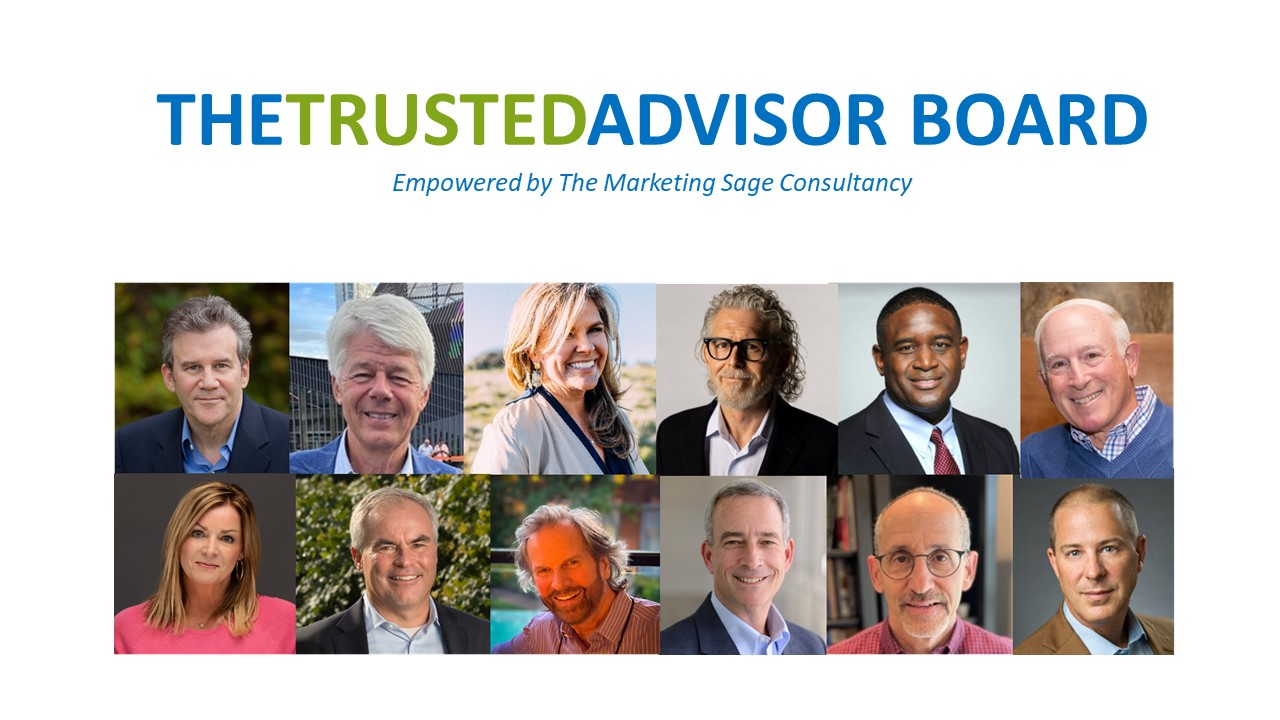
Instead of cobbling together your own advisory group, you work with experienced consultants to assemble a board of two to four seasoned advisors who meet with you twice per month or at a cadence that’s best for you.
Your advisors come with decades of combined experience across strategy, brand, marketing, operations, and sales.
They’re equipped to help you develop your one-to five-year goals and the plan to achieve them. They’ll give you honest feedback on everything from your product positioning to your go-to-market strategy. And critically, they tap into their own networks to bring real connections and resources to bear on your biggest challenges.
These are advisors who are emotionally invested in your success but not financially betting on your company, which means they can be both supportive and brutally honest.
The investment in a formal advisory board is reasonable, usually $5,000 per advisor per quarter. The investment often pays for itself quickly.
A single new customer or partnership that an advisor helps you secure can fund the entire engagement. More importantly, preventing a costly mistake—a bad distribution partnership, a misguided product launch, a marketing strategy that wastes months—can save you far more than the fee.
What This Solves for the Solo Entrepreneur
Running a business is isolating.
The decisions are yours. The accountability is yours. The doubt, at three in the morning, is yours alone. You can’t always talk to your team about your worries because you need to project confidence. You might not want to burden your family or your co-founder with every fear. So you carry it.
An advisory board breaks that isolation. Suddenly, you have people to help you process decisions. You have people to celebrate wins with. You have people who understand the specific challenges of building from zero and can remind you that what you’re experiencing is normal. That’s not a luxury.
That’s a necessity for sustainable entrepreneurship.
It also solves the blind spot problem. The founder is always too close.
You’ve been thinking about your situation for so long that you’ve become an expert in the weeds—and sometimes experts in the weeds miss the forest. An outside advisor, coming fresh, might ask a simple question that completely reframes your approach. “Why are you focused on direct-to-consumer when your customers are asking for retail distribution?” “Have you talked to people who didn’t buy from you?” “What would happen if you focused on half the problems?”
These simple questions, asked by someone removed from the day-to-day, are worth their weight in gold.
Three Key Takeaways for Founders
1. You don’t have to figure this out alone, and you shouldn’t. Building a great company is not a solo sport. The best founders I know actively seek input, challenge themselves with difficult questions, and surround themselves with people who make them better. An advisory board is the mechanism for making this happen consistently and deliberately. Whether you assemble your own informal group or engage a formal service, the structure matters less than the commitment to getting an outside perspective on your most important decisions.
2. Accountability and honesty are the real ROI. You’re not paying for advisors to listen to them talk. You’re paying for them to hold you accountable to your stated goals and to tell you truths that you can’t always tell yourself. That kind of feedback is uncomfortable sometimes, but it’s where real growth happens. Choose advisors who will challenge you, not just validate you.
3. Start building your network now. You don’t need to wait for a formal engagement to begin seeking advice. Start having coffee with people you admire. Begin asking for feedback on your product, your packaging, and your strategy. Pay attention to who gives you the most helpful input. Those are the people you eventually want on your advisory board. And be the kind of founder who, when you make it, is willing to return that favor for the next generation.
The road ahead is going to be hard. The market will test you. You’ll make mistakes. But you don’t have to face it alone. Build your kitchen cabinet. Get your advisors in place. And start benefiting from the wisdom of people who’ve walked this path before.
Your company will be better off having a Trusted Advisor Board. I promise.
Would you be interested in learning more about The Trusted Advisor Board? Please reach out to me here and schedule a free conversation.